
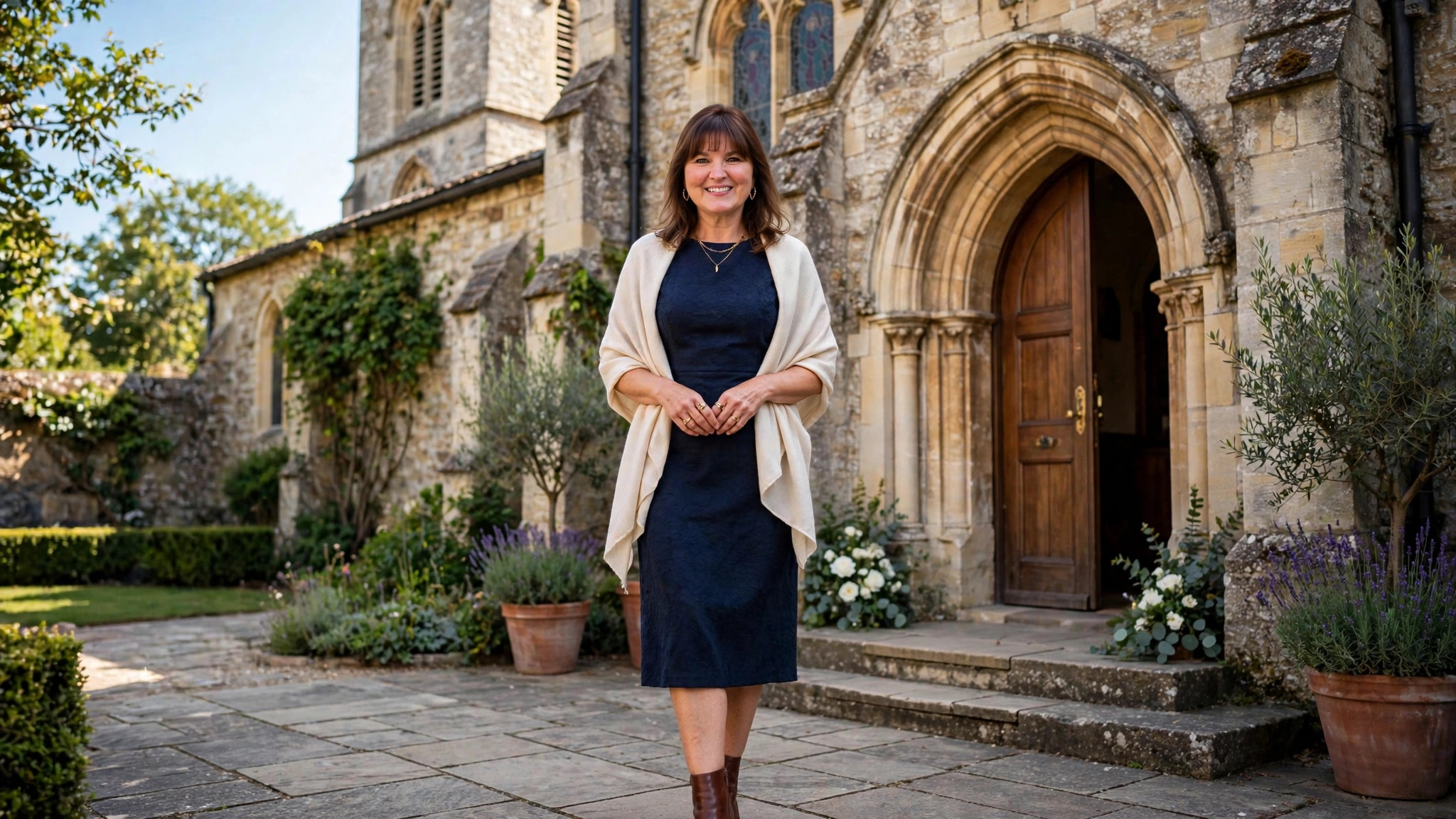
Church wedding guest outfits balance modesty with style: shoulders covered, a conservative neckline, a hemline at or below the knee, and a silhouette comfortable enough for a long service of sitting, standing, and kneeling. A church wedding guest outfit is modest occasion dressing for a sacred setting, where respect for the venue shapes every choice from sleeves to shoes. For a broader take on decoding wedding dress codes, see The Knot’s wedding guest dress code guide.
The dress code on the invitation still decides formality, and the etiquette basics in the complete wedding guest guide still apply. What changes in a church is the modesty baseline: coverage rules, denomination differences, and practical details like stone floors and pews. This guide covers the church-specific deep dive.
Key Takeaways
- The church modesty baseline is three coverage checks: shoulders, neckline, and hemline, and a removable layer solves most of them.
- Denomination matters: Catholic, Orthodox, Protestant, and Latter-day Saints weddings each carry different expectations for coverage and head coverings.
- Build the outfit around the ceremony, then remove a layer for the reception if the dress code allows.
- Stone floors, long services, and pews change shoe and bag choices in practical ways.
- One modest midi dress with two different layers can serve several weddings across denominations.
The Modesty Baseline: What Church Weddings Expect
Churches are places of worship first and wedding venues second, and church wedding guest outfits should reflect that. The baseline expectation at most church weddings is simple: cover your shoulders, keep your neckline conservative, and choose a hemline that falls at or below the knee. This is not about any single rule written in stone; it is a long-standing tradition of modesty during church services that varies by denomination and by how traditional the couple’s families are.
When in doubt, err on the side of more coverage. It is always easier to remove a shawl at the reception than to feel underdressed during the ceremony. The couple will remember that you showed up respectfully; no one remembers the exact outfit, but everyone notices the one that ignored the setting.

Shoulders, Necklines, Hemlines: The Three Coverage Checks
Run every church wedding outfit through three checks before you commit.
Shoulders. Covered shoulders are the most commonly expected element of church wedding attire. Sleeveless, strapless, and off-the-shoulder dresses can all work at a church wedding, but only with a layer for the ceremony: a shawl, wrap, bolero, blazer, or cardigan that stays on from seating through the recessional. Cap sleeves, short sleeves, three-quarter sleeves, and long sleeves need no layer at all.
Neckline. Keep necklines conservative: boat necks, square necks, modest V-necks, high necks, and jewel necklines all suit a church setting. Avoid plunging necklines and deep keyholes. A useful test is the seated test: sit down and lean slightly forward, the way you would during a service, and check what the neckline does. Necklines that behave when you are standing can shift when you sit.
Hemline. Aim for a hemline at or below the knee: knee-length, midi, tea-length, and maxi all work. Shorter hemlines become impractical in a church for a second reason beyond modesty: kneeling, standing, and sitting in rows of pews. A dress that rides up when you sit will need constant adjusting, which is distracting for you and everyone around you.
The Layering System: Shawls, Boleros, Blazers, and Jackets
Layering is the core skill of church wedding guest outfits because it lets one dress satisfy both the ceremony’s modesty expectations and the reception’s dress code. Think of the layer as modular coverage: on for the service, off or swapped for the party.
Shawls and wraps are the most flexible option. A lightweight pashmina-style wrap or chiffon shawl drapes over bare shoulders without adding bulk, folds into a clutch-sized bundle at the reception, and works across seasons. Choose a color that complements the dress rather than matching it exactly.
Boleros and cropped jackets give more structure. A bolero in lace, crepe, or satin reads as intentional occasion wear rather than an afterthought, and it photographs well. This is the best choice when the dress itself is sleeveless and the ceremony is traditional.
Blazers and tailored jackets suit cooler weather and more formal church weddings. A well-fitted blazer over a cocktail dress or a jumpsuit covers shoulders completely and adds polish; button it for the ceremony and remove it later. For summer, a lightweight unlined blazer or a knit cardigan in a refined fabric does the same job without overheating.
One practical note: whatever layer you choose, try it with the dress before the day. A shawl that slips off your shoulders every ten minutes is worse than no plan at all.
Denomination Differences: What Changes and What Does Not
Not all church weddings carry the same expectations. The denomination, and often the specific congregation, sets the tone. When you know the denomination, you can calibrate; when you do not, default to the more conservative end.
Catholic weddings tend to be the most conservative among common US denominations. Modesty is at the forefront: shoulders covered or a shawl on hand, hemlines at or below the knee, and conservative necklines. A full Catholic wedding mass involves sitting, standing, and kneeling, so comfort through movement matters. Checking the parish website for a stated dress code is a sensible step, and asking the couple when unsure is always acceptable.
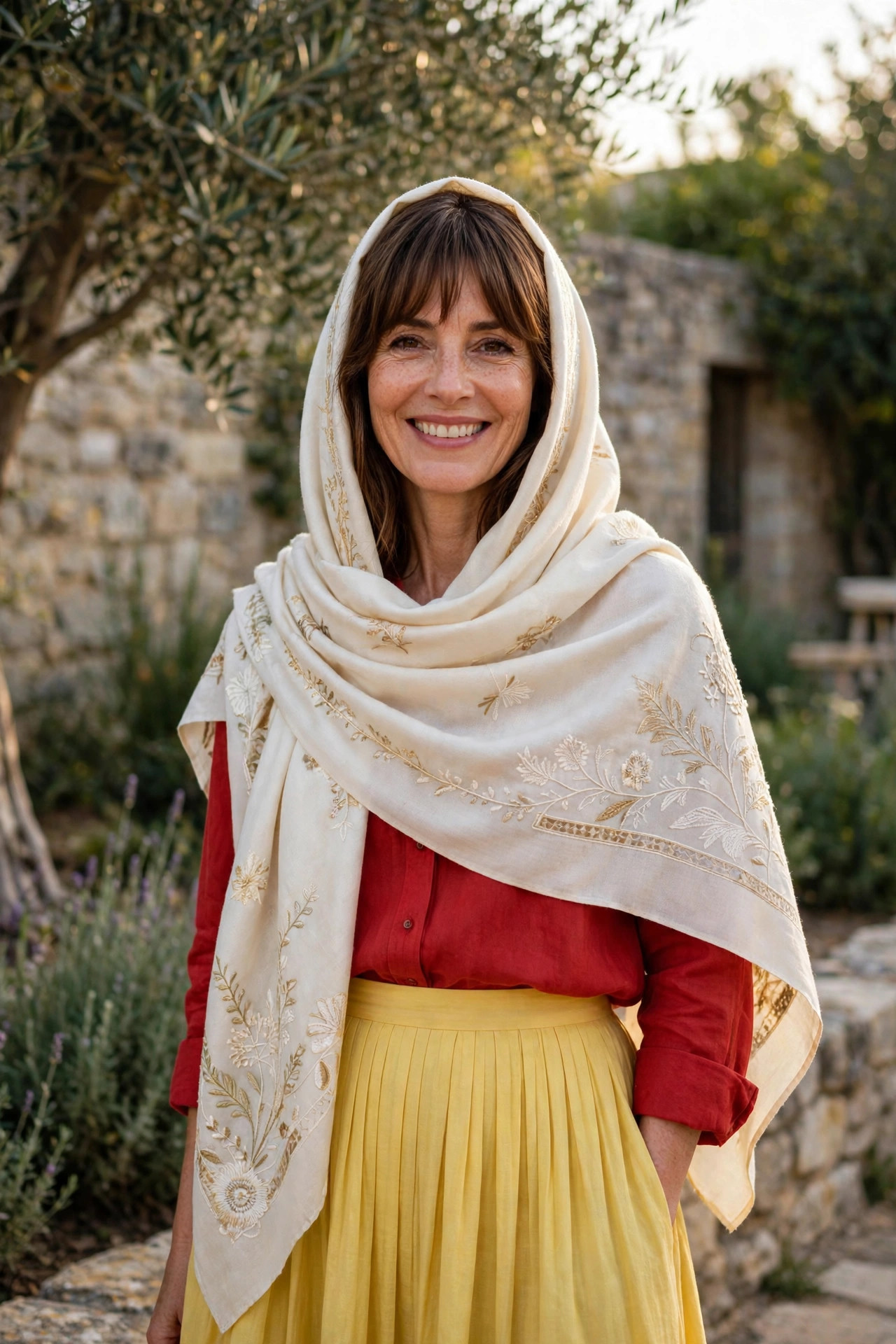
Orthodox weddings (Greek, Russian, and other Eastern Orthodox traditions) are similarly traditional, and some parishes expect women to cover their heads. A lightweight scarf or mantilla-style veil brought along as an option is a respectful precaution; you can observe what other women do and follow suit. Long sleeves or a layer, longer hemlines, and understated accessories fit the setting.
Latter-day Saints weddings take place in temples with strict modesty standards, though guests typically attend the sealing ceremony only if they hold a temple recommend; most guests attend the ring ceremony and reception instead. For those events, modest dress applies: covered shoulders, knee-length or longer hemlines, and conservative necklines.
Protestant weddings (Methodist, Lutheran, Presbyterian, Baptist, Episcopal, nondenominational) vary widely. Many are no stricter than a standard formal wedding, and sleeveless dresses without a layer are often perfectly fine. Episcopal and Lutheran services lean more traditional; nondenominational and Baptist services vary by congregation. The invitation and the couple’s families are your best guides.
For weddings in other faith traditions with a church-like sacred setting, the cultural considerations covered in the destination wedding guest guide apply: research local norms, cover more rather than less, and ask when unsure.
Church Wedding Guest Outfits Decoder
Find your ceremony type, then build the outfit around the modesty direction.
| Ceremony Type | Modesty Direction | Outfit Formula | Layer Plan |
|---|---|---|---|
| Catholic mass | Conservative: shoulders, neckline, knee-plus hemline | Midi or tea-length dress with sleeves, or a sleeveless dress plus layer; closed-toe shoes | Shawl, bolero, or blazer on for the full mass; remove at the reception |
| Orthodox ceremony | Traditional: coverage plus possible head covering | Longer dress with sleeves or a layer; understated jewelry | Bring a lightweight scarf for the head as an option; keep shoulders covered throughout |
| Traditional Protestant (Episcopal, Lutheran) | Respectful and polished | Knee-length or midi dress, tailored separates, or a jumpsuit with a layer | Blazer, cardigan, or wrap for the service; often fine to remove after |
| Contemporary Protestant or nondenominational | Standard formal wedding expectations | Cocktail dress or midi in a festive fabric; sleeveless usually acceptable | A light layer is still useful for air conditioning; optional for modesty |
| Latter-day Saints ring ceremony and reception | Modest: covered shoulders, knee-plus hemline | Dress with sleeves or a layer; conservative neckline | Keep the layer on through the ceremony portion |
| Evening formal church wedding | Conservative plus formal | Floor-length or formal midi gown with sleeves or a layer; richer fabrics | An elegant wrap or bolero that suits the gown; keep it on through the service |
Colors That Work in a Church Setting
The white rule is non-negotiable at a church wedding: avoid white, ivory, off-white, and champagne, anything that could read as bridal in photos. This matters even more in a church, where the ceremony photos are often the most formal and most kept.
Beyond white, church settings reward classic, subdued-to-moderate color choices. Pastels, soft florals, jewel tones, navy, burgundy, emerald, and muted earth tones all suit a sanctuary. Very bright neons can feel distracting in a solemn setting, though they are not forbidden; if you love bold color, choose a refined fabric and a modest cut so the color is the only statement.
Black deserves its usual nuance: it is widely accepted at formal and evening church weddings when the fabric and silhouette are clearly festive, and it can read as somber at a daytime service. For daytime church weddings, softer colors photograph better and feel more in keeping with the occasion. The complete wedding guest guide covers the black question in full. For evening formal inspiration, see cocktail party outfits.
Shoes for Stone Floors and Long Services
Church architecture changes footwear math. Stone, tile, and marble floors are hard, often slippery, and unforgiving over a long service, and many historic churches have steps, uneven aisles, and long walks from parking.
Choose shoes with a stable base: block heels, wedges, kitten heels, or dressy flats. Thin stilettos are risky on stone, they click loudly in a quiet sanctuary, and they punish feet through a ceremony that can run an hour or more before the reception even starts. If your heart is set on higher heels, a block heel gives the height with far more stability.
Break shoes in before the wedding, and consider the full timeline: ceremony, receiving line, photos, travel to the reception, dinner, and dancing can mean six or more hours. A pair of foldable flats tucked in your bag for the reception dance floor is a practical backup, not a fashion compromise.
Bags and Pew Etiquette
Pews are narrow, shared, and short on personal space, so bag choice matters more than it seems. A small clutch or a compact crossbody worn in front keeps your belongings contained and off your neighbor’s space. Large totes and bulky shoulder bags crowd the pew and end up on the floor, where they trip people during the standing and kneeling portions of the service.
Keep the phone away during the ceremony. Beyond basic courtesy, many couples request unplugged ceremonies, and a glowing screen in a dim sanctuary is impossible to miss. Photos can wait for the reception.
If the service includes communion or a similar ritual moment, follow the lead of those around you. Guests who are not of the faith typically remain seated or step aside quietly; there is no dress-code implication, but knowing the rhythm in advance keeps you comfortable.
What to Avoid at a Church Wedding
A short list of the most common missteps, so you can skip them all:
- Bare shoulders, plunging necklines, or very short hemlines with no layer for the ceremony.
- White, ivory, off-white, or champagne, anything that could photograph as bridal.
- Sheer fabrics without proper lining, cutouts at the waist or back, and anything that reads as clubwear.
- Loud stilettos on stone floors, or brand-new heels with no break-in period.
- Overly flashy accessories that draw attention during a solemn service; save statement pieces for the reception.
- Strong fragrance. Sanctuaries are enclosed spaces, and heavy perfume affects everyone in the pew.
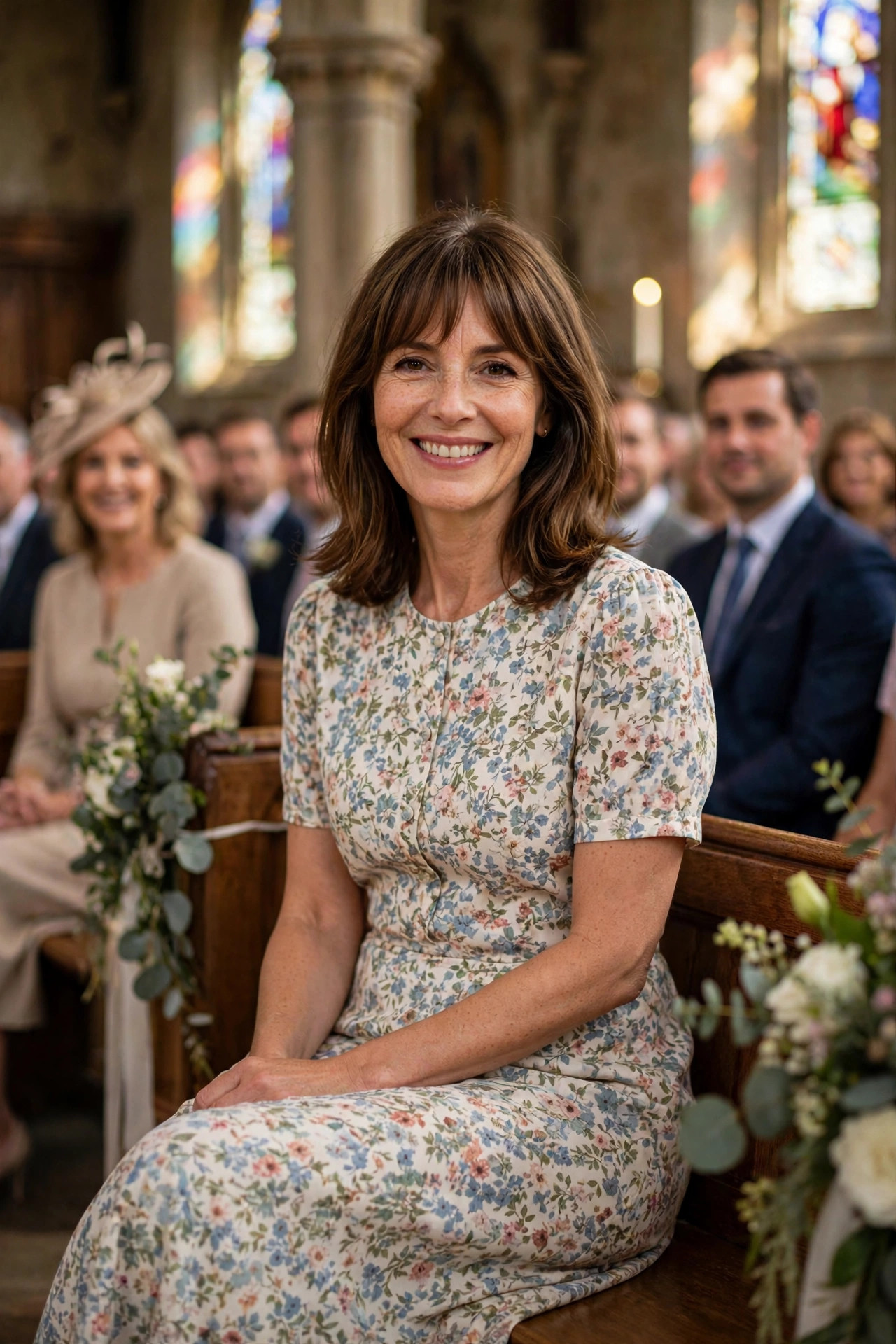
None of this requires a boring outfit. The best church wedding guest outfits prove that: a jewel-toned midi dress with three-quarter sleeves, a lace bolero, and block heels is fully church-appropriate and genuinely elegant.
Budget and Rewear: Making One Outfit Work Hard
Modest occasion dressing rewards rewearing, because the pieces are classic by design. A solid-color midi dress with sleeves is one of the most rewearable items a wedding guest can own: change the layer, the shoes, and the jewelry, and it serves a Catholic mass, a garden wedding, and a formal dinner without repeating itself visually.
The layer is where budget strategy lives. Instead of buying a new dress for every church wedding, invest in two or three versatile layers: a neutral shawl, a black or navy blazer, and a lace bolero. Each one transforms the same dress for a different denomination or formality level.
For guidance on building a rewearable wedding guest wardrobe on a budget, the fit-first approach in the plus-size dinner outfits guide and the closet-first strategies in why you always have nothing to wear apply directly: shop your closet first, prioritize fit over newness, and let accessories do the differentiating.
FAQs
What is the typical dress code for a church wedding?
The typical dress code for a church wedding is semi-formal to formal with a modesty baseline: shoulders covered or a layer on hand, a conservative neckline, and a hemline at or below the knee. Daytime church weddings lean semi-formal, while evening services lean formal. The invitation’s stated dress code still decides the formality level; the church setting adds the coverage expectations on top.
What should I wear to a Catholic wedding?
For a Catholic wedding, choose a modest dress with a conservative neckline and a hemline at or below the knee, and bring a shawl, bolero, or blazer to cover your shoulders during the mass if your dress is sleeveless. Catholic wedding masses involve sitting, standing, and kneeling, so pick a silhouette and shoes comfortable through movement. When unsure about a specific parish’s expectations, check the church website or ask the couple.
Do shoulders need to be covered in church?
Covering your shoulders is advised at most church weddings as a long-standing tradition of modesty, and it is more strongly expected at Catholic and Orthodox ceremonies than at contemporary Protestant ones. That does not rule out sleeveless or strapless dresses; it means bringing a shawl, wrap, bolero, or jacket to wear during the ceremony. Some churches post dress guidance on their websites, so check before the day.
What accessories are appropriate for a church wedding?
Understated accessories suit a church wedding: pearl or simple stud earrings, a delicate necklace, a small clutch or compact crossbody that fits in a pew, and a shawl or wrap that doubles as your shoulder coverage. Avoid anything overly flashy or distracting during the service, and keep fragrance light in the enclosed sanctuary. Save bolder statement pieces for the reception if the dress code allows.
Conclusion
Church wedding guest outfits come down to respectful coverage plus the dress code: cover shoulders, neckline, and knees, calibrate for the denomination, choose stable shoes for stone floors, and keep a layer in play for the ceremony. Get those right and the rest is the enjoyable part, color, silhouette, and styling that lets you celebrate comfortably all day. For outdoor ceremonies, garden wedding guest outfits covers grass-friendly dressing.

Rameen Awan is the founder and editor of Outfit Algorithm, where she breaks down outfit formulas, dress codes, and styling systems for real life. Her guides focus on practical details other sites skip: fabric behavior, fit for different body types, and what actually works when you are getting dressed in a hurry.