
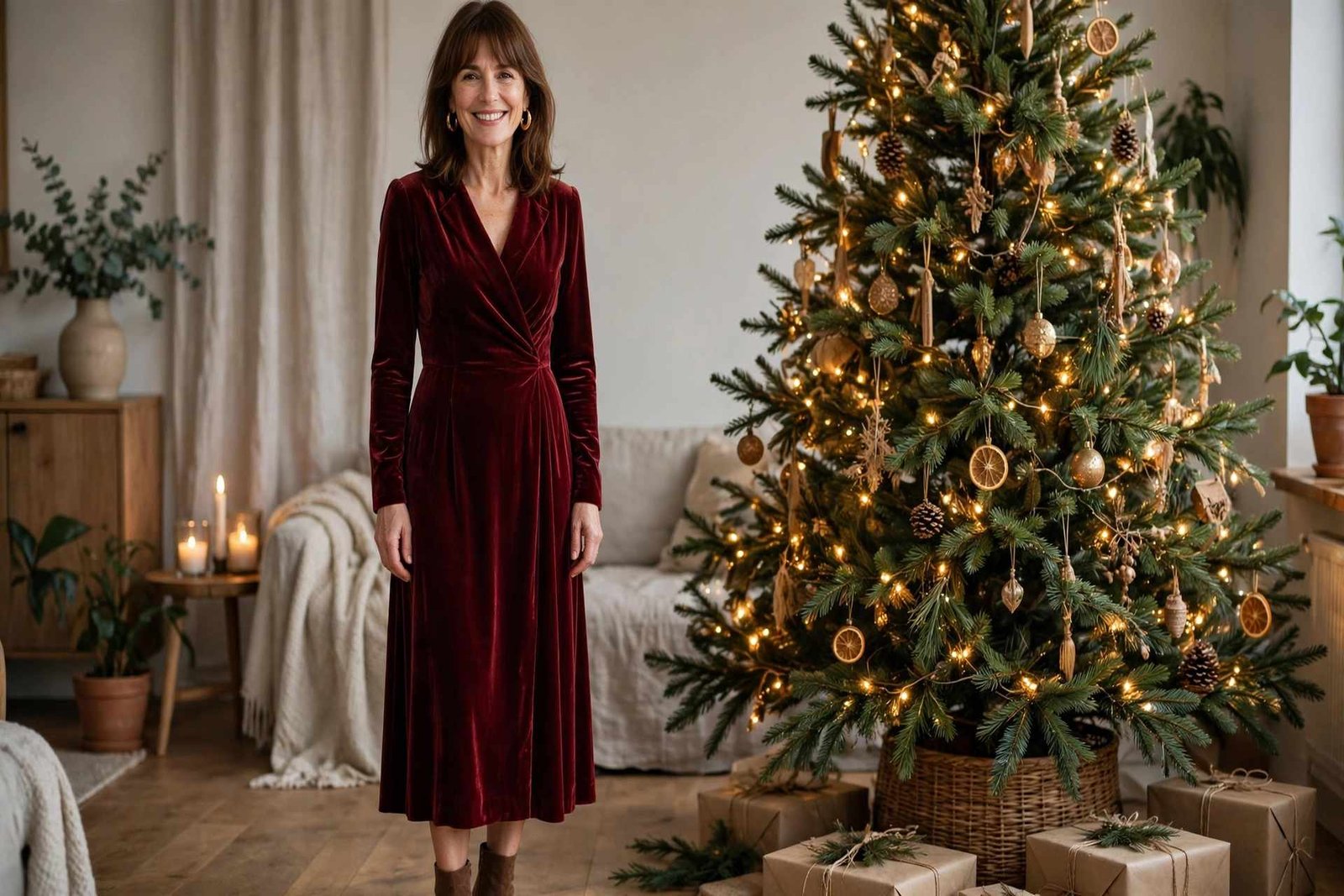
Christmas outfit colors do more work than any other styling choice in December. The right palette makes your skin glow under warm party lights, photographs beautifully against a tree, and signals festive without a single novelty print. The wrong palette washes you out, clashes with the room, or turns a polished outfit into a costume. The difference is rarely the individual color: it is the combination, and how the three colors in your outfit relate to each other.
Christmas outfit colors are the palettes, not just the single shades, that read festive in December: classic red and green, deep jewel tones, warm metallics, winter whites, and modern neutrals, chosen by skin tone and occasion. A good Christmas palette has three parts: a base color that covers most of the outfit, a secondary color that adds depth, and a small accent, usually a metallic, that catches the light. When those three work together, the outfit looks intentional in person and in photos.
This guide gives you 12 complete Christmas outfit color palettes, each with the exact three colors, the outfit to build from them, the skin tones they flatter, and the occasion they suit best, plus a skin-tone matching system, an occasion table, and photo tips. Pick one palette, build it from pieces you already own, and repeat one color in two places so the outfit holds together.
Quick Answer: What Colors Should You Wear for Christmas?
Start with your skin tone, then pick one palette of three colors. Warm skin tones glow in burgundy, forest green, cream, camel, and gold. Cool skin tones shine in emerald, sapphire, navy, silver, and optic white. Neutral skin tones can wear almost any palette, and midnight blue, forest green, and taupe are the safest middle ground. Whatever your tone, keep one color dominant, one supporting, and one metallic accent, and avoid wearing bright red and bright green together at equal strength, since that is the combination that reads like a costume.
- Three colors per outfit. A base, a secondary, and one metallic accent is the formula that always works.
- Deep shades beat bright shades. Burgundy beats bright red, forest green beats kelly green, and both photograph better.
- Repeat one color twice. A burgundy dress with burgundy lipstick, or a green skirt with green earrings, ties the outfit together.
- Metallics are the accent, not the base. Gold or silver in one place, jewelry, shoes, or a clutch, lifts the whole palette.
- Test in warm light. Christmas light is warm and yellow, so check your palette under a lamp, not under daylight alone.
What Are Christmas Outfit Colors?
Christmas outfit colors are the seasonal palettes built from the colors people associate with December: red, green, gold, silver, white, and black, plus the deeper and softer versions of each. The classic palette is red and green, but the modern Christmas wardrobe runs much wider, from jewel tones like emerald, ruby, and sapphire to neutrals like cream, camel, and chocolate, to metallics like gold, bronze, and silver.
What makes a color a Christmas color is context, not the shade alone. Burgundy is a Christmas color in a velvet dress under tree lights, and it is just a dark red in July. Emerald reads festive in a satin midi at a December dinner, and it reads like any other green in spring. Fabric matters as much as hue: velvet, satin, sequins, and tweed all push a color toward festive, while the same shade in a plain cotton tee reads everyday.
The palette system in this guide treats each color as part of a trio. Every palette below lists a base color, a secondary color, and an accent, and the outfit formula shows how much of each to wear. That ratio is what separates a polished Christmas outfit from a random red top with green pants: the base covers about two thirds of the outfit, the secondary covers about a third, and the accent is a small shine near the face or the hands.
How to Find the Christmas Colors That Flatter Your Skin Tone
Look at the veins on the inside of your wrist under natural light. If they lean blue or purple, your tone is cool. If they lean green, your tone is warm. If you see both, you fall in the neutral range, and you can wear palettes from either side. A second check is jewelry: if gold makes your skin glow, warm palettes will usually suit you, and if silver brightens your face, cool palettes are the safer bet.
Warm skin tones suit colors with depth and richness. Burgundy, forest green, terracotta, olive, mustard, and warm gold all add warmth without overpowering the face. Cream and camel work as light neutrals for warm tones, while bright white can look stark. Avoid orange-red and neon green, which can reflect unwanted color onto the skin in photos.
Cool skin tones suit colors with crisp clarity. Emerald, sapphire, navy, plum, silver, and optic white create contrast and sharpen the face in photos. Soft pink and icy blue work as light accents, while dull browns and mustard pull color away from a cool complexion. Deep skin tones with warm undertones glow in burgundy, royal blue, chocolate brown, and white, and should approach muddy beiges and pale yellow with care. Fair skin with cool undertones looks best in navy, soft pink, lavender, and gray, and should be careful with orange-red and neon green.
Quick Picks: 12 Christmas Outfit Color Palettes at a Glance
| Palette | Base | Secondary | Accent | Best for | Skin tone |
|---|---|---|---|---|---|
| 1. Classic Christmas | Burgundy | Forest green | Gold | Family, dinner | Warm, neutral |
| 2. Burgundy and Cream | Burgundy | Cream | Gold | Party, photos | All |
| 3. Emerald and Cream | Emerald | Cream | Gold | Dinner, party | Cool, neutral |
| 4. Navy and Silver | Navy | Silver | White | Evening, formal | Cool, fair |
| 5. Black and Gold | Black | Champagne | Gold | Evening party | All |
| 6. Chocolate and Burgundy | Chocolate brown | Burgundy | Gold | Daytime, dinner | Warm, deep |
| 7. Forest Green and Camel | Forest green | Camel | Gold | Daytime, casual | Warm, neutral |
| 8. Wine and Blush | Wine | Blush | Silver | Date night, dinner | Cool, fair |
| 9. Cream Neutrals | Cream | Oatmeal | Camel | Morning, photos | All |
| 10. Classic Plaid | Classic red | Forest green | Navy | Family, casual | All |
| 11. Sage and Chocolate | Sage | Chocolate | Cream | Daytime, brunch | Warm, neutral |
| 12. Modern Black and White | Black | Ivory | Silver | Evening, modern | Cool, neutral |
12 Christmas Outfit Color Palettes That Always Work
1. Classic Christmas: Burgundy, Forest Green, and Gold
This is the traditional Christmas palette with the brightness turned down. Instead of bright red and bright green on everyone, use deeper, richer shades: a burgundy velvet midi dress as the base, a forest green layer, a shawl, a coat, or a skirt, as the secondary, and gold as the accent in earrings, a clutch, or a belt. The deep shades read expensive, they photograph well under warm light, and they flatter almost every skin tone.
Build the outfit as a burgundy dress with a forest green coat, or a forest green sweater with burgundy trousers and gold jewelry. Keep the red and the green in different textures, velvet with knit, or satin with wool, so the two colors do not compete as flat blocks. This palette suits Christmas dinner, family gatherings, and any event where the photos include a tree, since burgundy and forest green sit naturally against greenery and warm lights. For the dinner side of this palette, the Christmas dinner outfits guide shows how the same colors work across a full evening plan.
2. Burgundy and Cream With Gold
Burgundy and cream with gold is the warmest Christmas palette, and the most forgiving on every skin tone. The burgundy does the festive work, the cream softens it, and the gold adds the shine that makes the outfit read celebratory rather than just dark. Use burgundy for the main piece, a knit, a dress, or trousers, cream for the layer, a coat, a blouse, or a scarf, and gold for the jewelry.
A burgundy velvet midi dress with a cream wool coat and gold earrings is the simplest version, and a burgundy sweater with cream wide-leg trousers and gold hoops is the daytime version. The cream keeps the outfit from disappearing in a dim room, which matters at evening events, and the gold near the face brightens photos taken by the tree. This palette suits parties, family photos, and dinners, and it is the best first pick if you are buying one new piece for the season, since burgundy works for Christmas and for the rest of winter. For a wider look at how burgundy carries a whole season, the Christmas outfits for women guide builds several outfits from the same deep red family.
3. Emerald and Cream With Gold
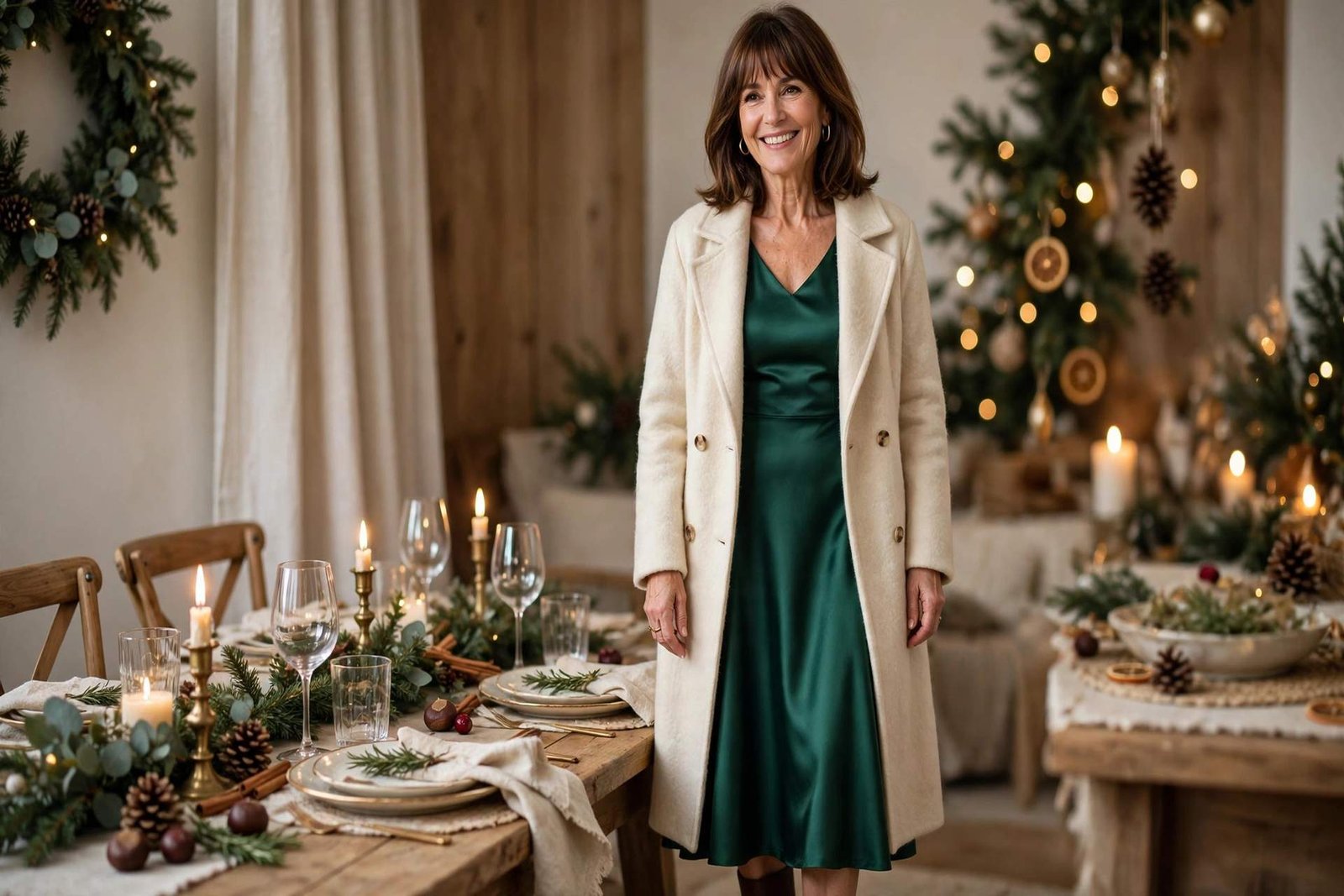
Emerald and cream with gold is the elegant alternative to red, and it suits cool and neutral skin tones especially well. The emerald reads festive without a single red piece, the cream keeps it soft, and the gold warms it up under party lights. An emerald satin midi dress with a cream coat is the party version, and an emerald sweater with cream trousers is the daytime version.
Emerald is the underrated Christmas color, and it photographs beautifully because it is saturated enough to stand out against both dark rooms and green trees. Keep the emerald in one large piece, a dress, a skirt, or a coat, and let the cream and gold support it rather than compete with it. This palette suits Christmas dinner, office parties, and evening events, and it is a strong choice for photos, since emerald and cream together read rich on camera without any filter. If you want a party-first version, the Christmas party outfit ideas for women guide uses emerald as one of its main party colors.
4. Navy and Silver With White
Navy and silver with white is the cool, formal Christmas palette, and it suits fair and cool skin tones best. The navy is deep enough to read festive at night, the silver adds the sparkle, and the white keeps the outfit crisp. A navy velvet dress with silver heels and a white or silver clutch is the evening version, and navy tailored trousers with a silver sequin top is the party version.
Navy works as a softer black for Christmas, and it pairs with silver better than black does, since the two cool tones share the same temperature. Add one light element, a white blouse, a silver scarf, or an ivory coat, so the outfit does not disappear in a dim room. This palette suits formal dinners, evening parties, and any event with candlelight, since silver catches the flame light and navy holds its depth. It is also the best palette for a work Christmas party, where black can feel too heavy and red can feel too casual.
5. Black and Gold With Champagne
Black and gold with champagne is the formal Christmas palette, and it flatters every skin tone because the black frames the face and the champagne softens it. The black does the heavy lifting, a velvet dress, a tailored jumpsuit, or a blazer and trousers, the champagne adds the light, a satin top, a silk blouse, or a slip skirt, and the gold adds the shine in jewelry, a clutch, or heels.
Champagne satin and black velvet with gold accents looks expensive and timeless, and it photographs well because the contrast between the dark and the light reads clearly on camera. Keep the gold to one or two places, earrings and a clutch, or a necklace and heels, so the outfit stays polished rather than glittery. This palette suits evening parties, New Year adjacent events, and any Christmas celebration that calls for a dress code above casual. Add a red lip if you want one festive note, and the outfit gains a Christmas signal without changing the palette.
6. Chocolate Brown and Burgundy With Gold
Chocolate brown and burgundy with gold is November and December’s richest color pairing, and it suits warm and deep skin tones especially well. The chocolate is the base, trousers, a coat, or a knit, the burgundy is the festive note, a dress, a blouse, or a scarf, and the gold warms both up. The two deep warm tones together read like a winter landscape, rich, soft, and grounded.
A chocolate brown knit with burgundy wide-leg trousers and gold hoops is the daytime version, and a burgundy velvet dress with a chocolate coat and gold earrings is the evening version. This palette is the best choice for a Christmas dinner at home or a family gathering, since it feels warm and relaxed rather than formal. It also works well for photos, because brown and burgundy together do not fight the warm tones of indoor light. If you already own chocolate pieces from fall, this palette is the easiest to build without buying anything new.
7. Forest Green and Camel With Gold
Forest green and camel with gold is the softer, woodland Christmas palette, and it suits warm and neutral skin tones well. The forest green reads festive without a single red piece, the camel softens it into something wearable for daytime, and the gold adds the holiday shine. A forest green sweater dress with a camel coat is the simplest version, and forest green trousers with a camel knit and gold jewelry is the separates version.
Camel is the neutral that makes green feel expensive rather than outdoorsy, and the combination photographs beautifully outdoors, against snow, evergreens, and winter light. This palette suits daytime parties, Christmas markets, family photos outside, and casual dinners, and it is the best pick if you want a Christmas outfit that still works in January, since neither color depends on the holiday to make sense. Keep the green deep, not bright, and the camel warm, not gray, so the two tones sit comfortably together.
8. Wine and Blush With Silver
Wine and blush with silver is the romantic Christmas palette, and it suits cool and fair skin tones best. The wine is deep and festive, the blush softens it into something gentle, and the silver cools the whole combination down. A wine satin midi dress with a blush coat is the evening version, and a wine sweater with blush trousers and silver earrings is the daytime version.
Blush is the light tone that keeps wine from reading too dark in photos, and silver is the metallic that matches the cool temperature of both colors. This palette suits a Christmas date night, a dinner for two, or a small gathering where the mood is intimate rather than loud. It is also a good choice for a work party, since wine reads polished and blush keeps it from feeling severe. Avoid gold with this palette, since the warm metallic fights the cool tones, and let the silver do the shining.
9. Cream, Oatmeal, and Camel Neutrals
Not every Christmas outfit needs red and green. Cream, oatmeal, and camel together create a warm, cozy Christmas look that photographs beautifully and feels calm next to a tree. The palette is all neutrals, so texture does the festive work: a cream sweater dress, an oatmeal knit, a camel coat, and a touch of shine from gold jewelry or a metallic clutch.
Cream sweater dresses, oatmeal knits, camel trousers, and chocolate sweaters together create a look that is warm without being loud, and it suits every skin tone because the neutrals sit close to the skin. This palette is the best choice for Christmas morning, a family photo session, or a casual day at home, since it looks soft and relaxed on camera. The risk with an all-neutral outfit is flatness, so mix textures, knit with velvet, wool with satin, and add one metallic accent near the face to keep the photos from looking washed out.
10. Classic Plaid: Red, Forest Green, and Navy
Classic red, forest green, and navy is the traditional plaid palette, and it is the most festive of the twelve without needing any sparkle. The plaid itself carries the Christmas signal, so the outfit can stay simple: a plaid skirt or a plaid scarf as the pattern piece, and solid red, green, or navy everywhere else. A red sweater with a green and navy plaid skirt is the daytime version, and a navy coat over a red dress with a plaid scarf is the evening version.
Plaid is a classic Christmas pattern that adds seasonal charm without glitter or embellishment, and it works best when the pattern is the only busy element in the outfit. Choose a pattern with red, green, navy, or subtle neutral shades, and keep the rest of the outfit solid so the plaid reads clearly. This palette suits family gatherings, casual parties, and Christmas morning, and it is the best pick for a family photo, since the plaid ties different outfits together when each person wears one color from the same pattern.
11. Sage, Beige, and Chocolate
Sage, beige, and chocolate is the soft, modern Christmas palette for daytime, and it suits warm and neutral skin tones well. The sage is a muted green that reads festive without shouting, the beige softens it, and the chocolate grounds it. A sage knit with beige trousers and a chocolate coat is the daytime version, and a sage satin skirt with a cream blouse and chocolate boots is the dressier version.
This palette works because the colors are all muted, so they sit comfortably together in natural light, and it photographs well outdoors, where the sage echoes evergreen tones without matching them exactly. It suits a Christmas brunch, a daytime party, or a casual family lunch, and it is the best pick if you find red and green too loud for your taste. Add a gold accent, a thin necklace or small hoops, to give the palette its holiday lift, and keep the rest of the outfit soft.
12. Modern Black, Ivory, and Silver
Black, ivory, and silver is the modern, minimal Christmas palette, and it suits cool and neutral skin tones best. The black is the base, the ivory is the light, and the silver is the shine, and together they create a look that is chic without being traditional. A black velvet blazer with an ivory satin top and silver heels is the evening version, and black tailored trousers with an ivory knit and a silver clutch is the daytime version.
This palette is a stylish twist on minimalism that photographs beautifully, especially in neutral or studio settings, because the contrast between black and ivory reads clearly on camera. It suits a modern Christmas party, a gallery-style event, or any celebration where the dress code is contemporary rather than classic. The risk is flatness, so mix textures, velvet with satin, wool with silk, and add the silver near the face, earrings or a necklace, so the outfit does not disappear in a dim room. For the party styling side of this palette, the white dress Christmas party outfit guide shows how ivory and white carry a festive look without red or green.
Which Christmas Colors Photograph Best?
Burgundy, forest green, cream, and classic red photograph best for Christmas, because they read rich on camera and complement tree lights and greenery without clashing. Deep jewel tones hold their color under warm indoor light, while bright red and bright green can blow out or reflect onto skin. Cream and champagne are the safest light tones, since they brighten the face without washing it out, and black photographs well when it has a light layer or a bright lip nearby.
Coordinate, do not match. Pick two or three colors and let everyone wear a different piece in that palette, so the photo looks intentional without looking like a uniform. Skip busy logos, neon colors, and clashing patterns, since they compete with faces and the holiday set. Thin stripes can shimmer on camera, so choose solid knits and simple plaids instead. Think in textures: knit, velvet, tweed, chiffon, ribbed cotton, and satin add depth without busy prints, and they photograph better than flat fabrics.
Test your palette under the actual light of the event. Warm yellow party lights make optic white look almost blue, so ivory or champagne photographs better under them, while cool white lights or daylight make optic white look crisp and clean. Stand near the tree, take one test photo, and check whether the colors still read the way you want them to. If the outfit disappears into a dark background, add a light layer or a metallic accent near your face, and the photos will hold up. For more photo planning, the Christmas photoshoot outfits guide covers palettes and poses that work on camera.
What Christmas Colors Should You Avoid?
Neon and extremely bright colors are the main ones to avoid, since they reflect unwanted color onto skin in photos and clash with warm indoor light. Bright red and bright green worn together at equal strength are the second problem, since the combination reads like a costume rather than an outfit. If you love both colors, use one as the base and the other as a small accent, a scarf, a pair of earrings, or a clutch, and the outfit stays festive without tipping into fancy dress.
Orange-red is risky for warm skin tones, since it can wash out the face unless it is paired with cream or navy for balance. True red flatters cooler complexions best when it is combined with soft whites or icy pastels. Muddy beiges and pale yellow are the colors to approach with care on deeper skin tones, and yellow-based whites are risky for medium and olive skin tones. None of these colors is banned, and each can work with the right pairing, but they need more care than the twelve palettes above.
The simplest safety check is the three-color rule: if your outfit has more than three strong colors, remove one. A burgundy dress, a cream coat, and gold jewelry is a palette. A burgundy dress, a green coat, a gold bag, a silver shoe, and a red lip is a collection. The first photographs as an outfit, and the second photographs as a pile of festive pieces.

What colors should I wear for Christmas?
Red, burgundy, forest green, cream, gold, and black are classic Christmas colors. Choose the ones that suit your skin tone and wardrobe: warm skin tones glow in burgundy, forest green, cream, camel, and gold, while cool skin tones shine in emerald, sapphire, navy, silver, and optic white. Pick one palette of three colors, a base, a secondary, and one metallic accent, and repeat one color in two places so the outfit holds together.
What are good colors to wear for Christmas?
Red and green are the classic colors of Christmas, but they are hard to pull off without looking like an elf or a tree. Gold, silver, and white are more wearable and glamorous options, and they can be adapted to suit your skin tone. For Christmas photos, consider deeper red and green tones, think emerald and crimson, paired with black or navy. Jewel tones like emerald, ruby, and sapphire are universally flattering and instantly feel luxurious.
What colors work best for a Christmas party outfit?
Red, deep green, champagne, silver, and black are the classics: they photograph well and feel instantly festive. Jewel tones like emerald also shine under party lights. When in doubt, match the event: bold brights for lively parties, darker tones for formal ones. Emerald, burgundy, champagne, navy, and black are reliably flattering and photograph well in candlelight, and metallics and sequins work beautifully for New Year’s Eve.
What colors photograph best for Christmas family photos?
Burgundy, forest green, cream, and classic red photograph best. They read rich on camera and complement tree lights and greenery without clashing. Coordinate, do not match: pick two or three colors and let everyone wear a different piece in that palette. Skip busy logos, neon colors, and clashing patterns, and choose solid knits and simple plaids instead, since thin stripes can shimmer on camera.
How do you choose a Christmas outfit?
Start with your plan for the day, then pick one palette of three colors that suits your skin tone. Christmas colors do not have to be red and green: burgundy, forest green, cream, camel, black, and gold all feel festive and are easier to wear. Stick to two or three colors, for example cream, camel, and gold, and add one festive detail, a velvet texture, a touch of red, a satin skirt, or a sparkly earring, to pieces that already fit you well.
Conclusion / Key Takeaways
Christmas outfit colors work when three rules hold: pick one palette of three colors, match it to your skin tone, and repeat one color in two places. Deep shades beat bright shades, metallics work as an accent rather than a base, and the occasion decides whether the palette is classic, romantic, or modern. Burgundy and cream with gold is the safest first palette, emerald and cream is the most elegant alternative to red, and black and gold with champagne is the most formal.
Start with the palette that matches your skin tone and your plans, build it from pieces you already own, and test it under warm light before the event. The colors that photograph best, burgundy, forest green, cream, and classic red, are also the colors that feel most festive in person, so the outfit that looks right in the mirror usually looks right in the photos too. Pick one palette, wear it with confidence, and let the colors do the festive work. For the skin-tone science behind these palettes, the guide to choosing colours that flatter your skin tone for Christmas explains the warm, cool, and neutral system in detail.

Rameen Awan is the founder and editor of Outfit Algorithm, where she breaks down outfit formulas, dress codes, and styling systems for real life. Her guides focus on practical details other sites skip: fabric behavior, fit for different body types, and what actually works when you are getting dressed in a hurry.