

Awards ceremony outfits sit in a narrow band between office polish and evening glamour. The right outfit reads as respectful, camera ready, and comfortable enough to wear from the first speech to the last photo. The wrong one either fades into the background or pulls focus away from the people being honored. This guide gives you a simple decision path first, then 12 complete looks for daytime luncheons, evening cocktails, and black tie galas, plus fit notes for petite and plus-size frames and a short checklist for shoes, bags, and photos.
An awards ceremony is a work event with a stage, an audience, and a camera. Your outfit has to do three jobs at once. It has to match the formality on the invitation, it has to let you sit, stand, climb stage steps, and hold an award without fuss, and it has to photograph well under bright lights. Every look below is built around those three jobs, so you can pick by your role, honoree, presenter, or guest, and by the time of day.
What Should You Wear to an Awards Ceremony?
Start with the invitation, then the clock, then your role. The invitation is the single most reliable source. If it names a dress code, follow it exactly. If it says nothing, the time of day decides the baseline. A daytime ceremony calls for polished business attire, a tailored suit, a structured midi dress, or dressy separates. An evening ceremony calls for one step more formality, a cocktail dress, a refined jumpsuit, or a floor-length gown for black tie. Your role adds the final adjustment. Honorees and presenters dress one notch above the room average, because they will be on stage and in photos. Guests match the room and keep the styling a little quieter.
A useful test is the senior person test. Picture the most senior person in your department on stage at this event. Match that level of formality, then adjust for your own role and comfort. If you are accepting an award, choose solid colors that photograph cleanly, a defined waist or shoulder line, and shoes you can walk up steps in. If you are presenting, pick an outfit that stays neat when you lean toward a microphone and reach for an envelope or a trophy.
How Do You Pick the Right Level of Formality?
Formality runs on a simple ladder, from business casual up to black tie. Most work ceremonies sit in the middle of that ladder. A lunchtime awards event is usually business formal or semi-formal. An evening awards dinner is usually cocktail or black tie. The table below maps each level to a women’s outfit, so you can place your event in seconds.
| Formality level | When you see it | What to wear |
|---|---|---|
| Business casual | Daytime, internal team awards | Tailored trousers, silk blouse, blazer |
| Business formal | Daytime, industry or company awards | Pantsuit, sheath dress with jacket, structured midi |
| Semi-formal | Afternoon luncheon, regional awards | Refined midi dress, dressy separates, polished jumpsuit |
| Cocktail | Evening awards dinner | Knee-length or midi cocktail dress, evening jumpsuit |
| Black tie | Evening gala, national awards | Floor-length gown or formal evening separates |
If the invitation names a code you do not know well, check the site’s dress code guides before you shop your closet. The black tie dress code guide explains floor-length expectations and evening fabrics, the cocktail dress code guide covers knee-length and midi options for evening dinners, and the business casual dress code guide sets the daytime baseline. For a second opinion on ceremony dress codes in general, the August Awards guide to what to wear to an awards ceremony walks through business, cocktail, formal, and black tie at awards dinners, including advice for finalists.
When no code is listed at all, dress one notch more formal than you think the room will be. Being slightly overdressed at an awards ceremony reads as respect. Being underdressed reads as a mistake, and it shows in every photo. If you are still unsure after reading the invitation, look at photos from last year’s event or ask the organizer. Both take five minutes and remove the guesswork.
12 Awards Ceremony Outfits That Work
The 12 looks below cover every common ceremony, from a daytime team luncheon to a black tie gala. Each one names the pieces, the colors that work best, and the role it suits. Use the Quick Picks table to find your event fast, then read the full formula for the details.
| Look | Outfit | Best for | Formality |
|---|---|---|---|
| 1 | Navy tailored pantsuit | Honoree, daytime | Business formal |
| 2 | Charcoal blazer and wide-leg trousers | Guest, daytime | Business formal |
| 3 | Burgundy structured midi with blazer | Honoree, luncheon | Semi-formal |
| 4 | Black sheath dress with cropped jacket | Presenter | Business formal |
| 5 | Emerald jewel-tone midi dress | Guest, evening | Cocktail |
| 6 | Black floor-length gown | Honoree, gala | Black tie |
| 7 | Tailored crepe jumpsuit | Guest, evening | Cocktail |
| 8 | Navy wrap midi dress | Guest, semi-formal | Semi-formal |
| 9 | Velvet blazer with tailored trousers | Guest, winter evening | Cocktail |
| 10 | Cream suit with silk blouse | Guest, daytime spring | Business formal |
| 11 | Satin slip midi with structured blazer | Guest, cocktail | Cocktail |
| 12 | Sequin top with tailored black trousers | Guest, festive evening | Cocktail |
1. The Navy Tailored Pantsuit
A navy pantsuit is the strongest daytime choice for an honoree. Navy reads as authoritative on stage without the severity of black in daylight, and a tailored suit photographs as a clean, unbroken line from every angle. Choose a single-breasted blazer with a defined shoulder and straight-leg or slightly tapered trousers that break just above the shoe. A white or ivory silk blouse underneath keeps the look bright under stage lights, and pointed closed-toe heels in navy or nude finish it.
Fit matters more than the label. The blazer shoulder seam should sit exactly on your shoulder, the sleeve should end at the wrist bone, and the trousers should skim, not cling. A petite frame should pick a cropped or ankle-length trouser so the leg line stays long. A plus-size frame should pick a blazer that buttons without pulling and trousers with a flat front and a mid-rise waist. Add one quiet piece of jewelry, small studs or a thin bracelet, and a structured tote or top-handle bag for the daytime event.
2. The Charcoal Blazer and Wide-Leg Trousers
Charcoal is the guest’s answer to navy. It is formal, forgiving, and easy to wear for a long ceremony. Pair a charcoal blazer with matching wide-leg trousers and a silk camisole or fine-knit top in ivory, blush, or soft grey. The wide leg gives the outfit movement and comfort for sitting through speeches, and the matching set keeps it looking intentional rather than assembled from office separates.
Keep the top tucked in and the waistband visible, because the waist is what gives wide-leg trousers their shape. A slim belt in a dark tone marks the waist without adding bulk. Shoes should be closed-toe with a low block heel or a pointed flat, so you can walk across a ballroom floor and up a few steps without wobbling. This look works for daytime and early evening ceremonies, and it transitions to dinner with a change of jewelry and a clutch instead of a tote.
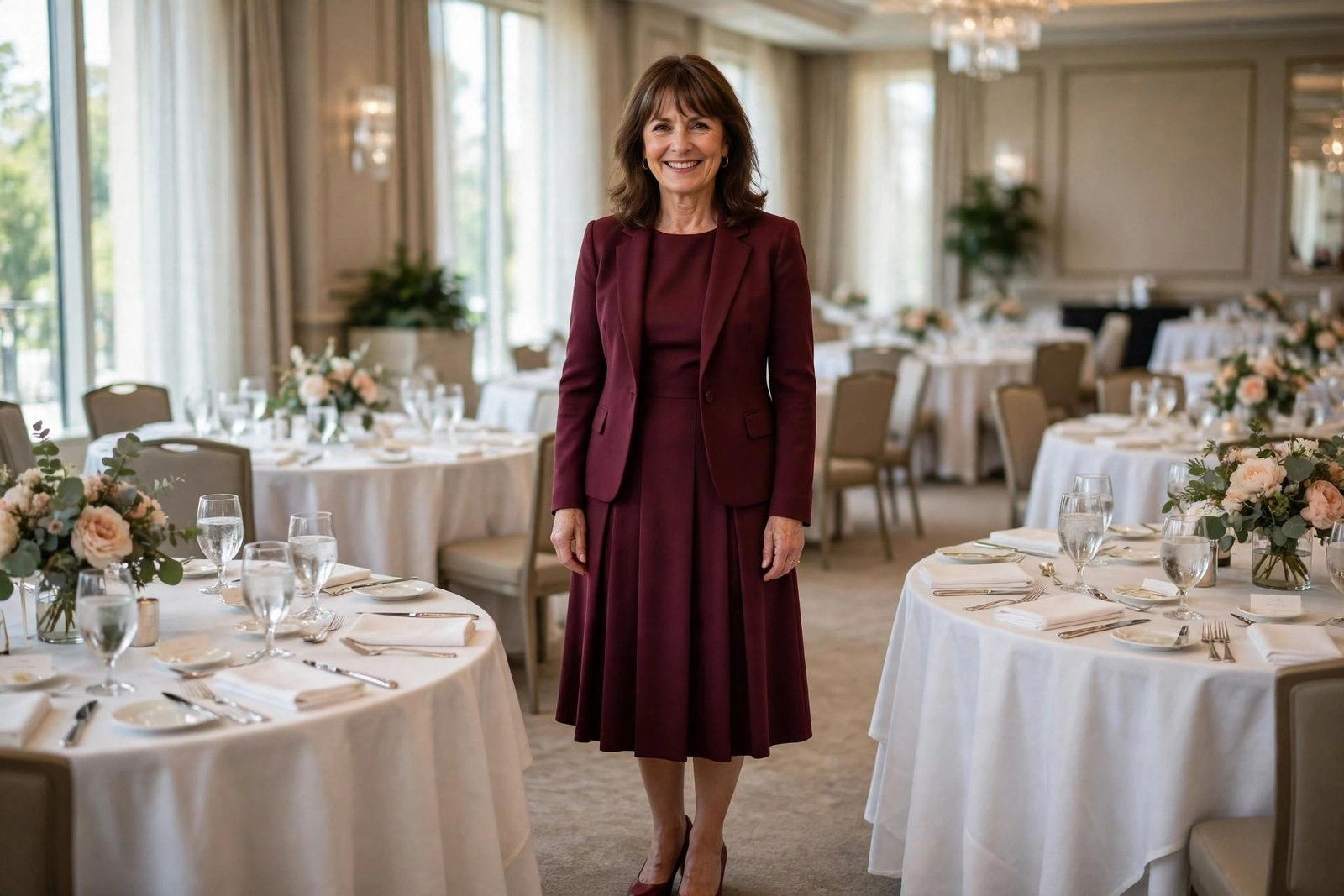
3. The Burgundy Structured Midi Dress With a Blazer
A burgundy midi dress with a matching or navy blazer is the classic awards luncheon outfit. Burgundy is rich in daylight, flattering on many skin tones, and distinct enough that you will not blend into a room full of black and navy. The dress should have a defined shape, a sheath or A-line cut, a knee to midi length, and a fabric with enough weight to hold its line, such as crepe or a ponte knit. The blazer adds structure and warmth in an air-conditioned ballroom.
Wear the blazer open over the dress for the reception and buttoned for the ceremony itself, which gives you two looks from one outfit. Closed-toe heels in burgundy or nude keep the leg line clean. A small structured handbag holds the essentials without competing with the dress. For a petite frame, choose a midi that ends just below the knee rather than mid-calf, so the proportions stay balanced. For a plus-size frame, a wrap-style bodice or a defined waist seam gives shape without a belt.
4. The Black Sheath Dress With a Cropped Jacket
Presenters need an outfit that stays neat through a long stretch of standing, leaning toward a microphone, and handing over awards. A black sheath dress with a cropped jacket does that job well. The sheath gives a clean silhouette, the cropped jacket defines the waist and covers the upper arms, and the whole outfit moves with you instead of against you. Choose a knee-length sheath in crepe with a modest neckline, and a jacket that ends at the waist so the proportions stay crisp.
Keep the jewelry minimal, because a presenter is on camera for long stretches and anything that catches light or swings will distract. Small studs, a slim watch, and a simple bracelet are enough. Shoes should be closed-toe pumps with a heel height you can stand in for an hour. Carry nothing on stage. Leave your bag at your seat and keep your hands free for the envelope, the trophy, and the handshake. A small pocket in the jacket is handy for cue cards.
5. The Emerald Jewel-Tone Midi Dress
An emerald midi dress is a strong evening choice for a guest who wants color without sparkle. Jewel tones photograph beautifully under warm evening light, and emerald suits a wide range of skin tones. Look for a midi with a defined waist, a modest neckline, and a fabric with a soft sheen, such as satin-backed crepe or a matte silk. A short sleeve or a sleeveless cut with a light wrap or shawl covers both options for a cool ballroom.
Pair it with metallic or nude closed-toe heels and a small clutch in gold or black. Keep the rest of the styling quiet, one statement piece at most, so the color does the work. A delicate pendant or small drop earrings are enough. This dress suits cocktail and semi-formal evening ceremonies, and it is a good pick when the invitation says evening attire without naming black tie. Hem length matters here. A midi that ends at the widest part of the calf can shorten the leg, so aim for just below the knee or just above the ankle.
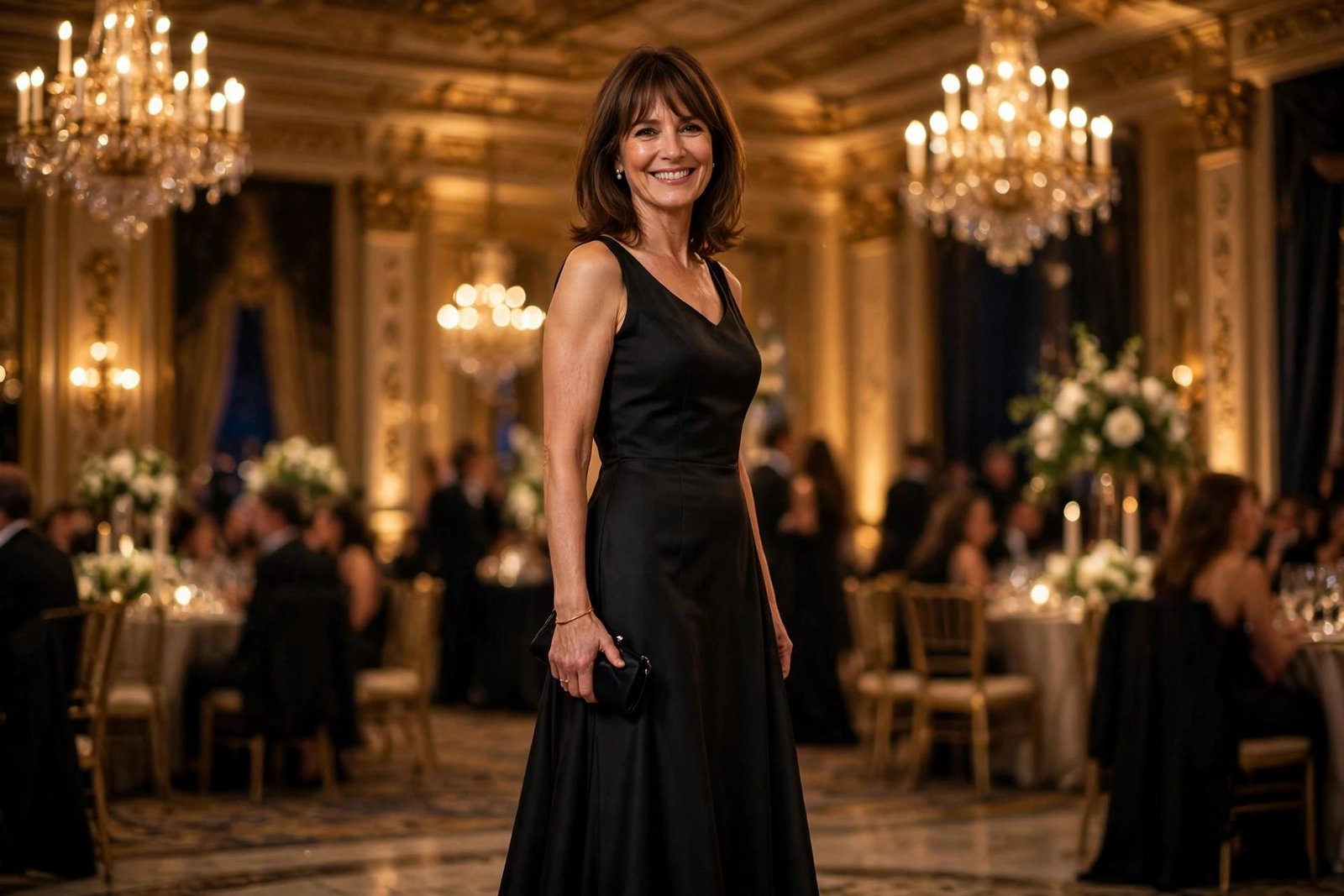
6. The Black Floor-Length Gown
A black floor-length gown is the standard for a black tie awards gala, and it earns its place by being simple to style and hard to get wrong. Choose a clean silhouette, a column or A-line cut, with a modest neckline and a fabric that drapes rather than clings, such as crepe, matte silk, or chiffon over a lining. Controlled detail is the rule. One feature, a draped bodice, a low back, or a subtle slit, is enough. Heavy beading and sequins all over the gown can look busy under stage lights and photographs.
Try the gown on with the exact shoes you will wear, because the hem must graze the floor evenly and clear the stage steps. A petite frame should look for a gown with a defined waist and a shorter bodice length, and should budget for a hem adjustment, since most floor-length gowns are cut long. A plus-size frame should look for a gown with a structured bodice and a skirt that falls from the waist without clinging at the hip. Finish with a small clutch, simple jewelry, and an updo or a polished blowout that keeps hair off the shoulders for photos.
7. The Tailored Crepe Jumpsuit
A tailored jumpsuit in a solid dark color is the modern alternative to a dress at an evening ceremony. It suits guests who prefer trousers, and it photographs as a strong, confident line. Choose a crepe jumpsuit in black, navy, or deep plum with a defined waist, a wide-leg cut, and a neckline you are comfortable wearing for hours. A blazer over the shoulders turns the same jumpsuit into a business formal outfit for an earlier event, which makes it a useful piece beyond the ceremony.
Fit is the whole game with a jumpsuit. The torso length must match yours, or the waist will sit in the wrong place and the fabric will pull when you sit. Try it sitting down, not just standing, and check that the waist stays put. Heels with a closed toe and a stable heel keep the wide leg from pooling on the floor. Keep the bag small and structured, and keep jewelry to one focal point, such as statement earrings or a cuff. Skip a long necklace, which can tangle with the neckline.
8. The Navy Wrap Midi Dress
A navy wrap midi dress is the most forgiving semi-formal choice in this guide, and it works for almost every body type. The wrap waist defines the waistline, the V-neckline lengthens the neck, and the skirt skims the hip without clinging. Navy is safe for conservative industries, and it looks polished in both daylight and evening light. Choose a wrap dress in a crepe or jersey with enough weight to hold its shape, and make sure the wrap ties securely at the waist with no gaping at the bust.
Style it with nude or navy closed-toe heels and a structured handbag in a dark neutral. A thin belt in the same navy can sharpen the waist further, but it is optional. For a petite frame, a wrap dress with a shorter skirt, ending just below the knee, keeps the proportions balanced. For a plus-size frame, a wrap dress with a true wrap, not a faux wrap, adjusts to the waist and gives the best fit. A small safety pin at the crossover point is a cheap fix for any gaping, and it stays invisible in photos.
9. The Velvet Blazer With Tailored Trousers
A velvet blazer is the winter evening answer to a plain suit jacket. It adds texture and warmth without adding sparkle, and it turns an ordinary trouser outfit into a ceremony outfit. Pair a deep green, burgundy, or black velvet blazer with tailored black trousers and a silk camisole or a fine-knit top in ivory or black. The contrast between the soft velvet and the smooth trousers gives the outfit depth, and the blazer keeps you warm in a cold ballroom.
Keep the rest of the outfit simple, because velvet is already a statement fabric. A slim belt, a small clutch, and closed-toe heels in black are enough. Avoid a velvet trouser in the same color, which can look like a costume rather than a suit. This look suits cocktail and semi-formal winter ceremonies, and it works well for guests in creative industries where a plain suit would feel too stiff. Velvet crushes easily, so hang the blazer, not fold it, and steam it lightly before the event.
10. The Cream Suit With a Silk Blouse
A cream or ivory suit is a fresh daytime choice for spring and early summer ceremonies. It photographs brightly in daylight and stands out in a room full of dark suits, which is useful for an honoree. Choose a tailored cream blazer and matching trousers or a knee-length skirt, and pair them with a silk blouse in a soft tone such as blush, pale blue, or sage. The blouse adds color without breaking the light palette.
Cream demands clean lines and good fabric, because every wrinkle and stain shows. Choose a suiting fabric with a little structure, such as a wool blend or a heavy crepe, and press the suit the morning of the event. Shoes in nude or metallic tones keep the leg line long, and a structured bag in a light neutral finishes the look. This suit is best for daytime ceremonies, since cream reads as too light for a black tie evening. If the event runs into the evening, swap the blouse for a deeper tone and add a clutch to shift the mood.
11. The Satin Slip Midi With a Structured Blazer
A satin slip midi dress with a structured blazer is a cocktail look that balances softness and structure. The slip dress brings a gentle sheen and a fluid line, and the blazer keeps it from reading as evening-only or too delicate for a work event. Choose a slip midi in a deep tone such as navy, burgundy, or forest green, and a blazer in black or the same tone. The blazer should be structured at the shoulder and end at the hip, so it frames the dress rather than swallowing it.
Wear the blazer on for the ceremony and off the shoulder for the reception, which gives you two looks without a change of outfit. Closed-toe heels in a metallic or nude tone work well, and a small clutch holds the essentials. A slip dress can cling, so choose one with a lining and check it in bright light before the event. For a petite frame, a slip midi that ends just below the knee is the safest length. For a plus-size frame, a bias-cut slip with a lining drapes better than a straight-cut one.
12. The Sequin Top With Tailored Black Trousers
A sequin top with tailored black trousers is the restrained way to wear sparkle at a festive evening ceremony. The rule is one sparkle piece per outfit, and the top is the right place for it. Choose a sequin top in a dark tone, such as black, navy, or deep gold, with a modest neckline and a relaxed fit, and pair it with flat-front black trousers and closed-toe heels. The trousers keep the outfit grounded, so the sequins read as celebration, not costume.
Keep jewelry minimal, because sequins already catch the light. Small studs and a plain clutch are enough. A black blazer over the top tones the look down further for a conservative room, and you can remove it for photos. This look suits holiday-season ceremonies and festive industry awards, and it is a good pick when the invitation says cocktail or festive attire. Avoid a full sequin dress at a work ceremony, which can look like a party outfit rather than a work outfit, and avoid sequins at a daytime event, where they can look out of place.
How Should Honorees Dress Differently From Guests?
Honorees dress one notch above the room. That is the whole difference, and it is easy to apply. If guests wear business formal, the honoree wears a sharper version of it, a better-fitting suit, a richer color, or a dress with a more defined silhouette. If guests wear cocktail, the honoree wears a gown or a more formal cocktail dress. The honoree’s outfit should also be the most camera-ready in the room, because the honoree will be photographed on stage, at the podium, and holding the award.
Three practical checks help. First, the outfit must stay secure through the whole stage moment, sitting, standing, walking up steps, reaching for the award, and posing. Test all of it at home. Second, the outfit should read clearly in a photo taken from ten feet away, so solid colors and defined lines beat busy prints. Third, the shoes must handle stage steps in low light. A stable heel and a closed toe are safer than a stiletto or a strappy sandal. Guests, by contrast, can relax each of these checks by one step, quieter colors, a simpler silhouette, and shoes chosen for comfort over the whole evening.
What Shoes and Bag Complete the Look?
Shoes and bags are where ceremony outfits most often go wrong, so treat them as part of the outfit, not an afterthought. Closed-toe shoes are the safest choice for every ceremony level, from daytime business formal to black tie. A modest peep-toe heel is acceptable at most evening events, but strappy sandals and open-toe flats read as too casual for a formal room. Choose a heel height you can stand in for an hour and walk up steps in, and break the shoes in before the event, not on the day.
The bag follows the formality. A structured tote or top-handle bag suits a daytime ceremony. A small clutch or a structured evening bag suits an evening ceremony. A large everyday handbag is wrong at every level, because it competes with the outfit and looks out of place in photos. Keep the bag small, dark, and structured, and carry only the essentials, phone, keys, lip color, and the invitation. A camera-ready checklist helps on the day: shoes broken in, hem checked with the ceremony shoes on, outfit steamed, jewelry chosen, bag packed, and a quick photo taken at home to check the whole look in a mirror and on camera.
How Do You Dress for an Awards Ceremony on a Budget?
A ceremony outfit does not need to be new. The closet-first approach starts with what you already own and adds only the missing piece. A tailored blazer you own, a midi dress from a past event, or a good pair of black trousers can all become a ceremony outfit with the right styling. The missing piece is usually one item, a structured blazer, a pair of closed-toe heels, or a small clutch, and buying one good piece beats buying a whole new outfit that you will wear once.
Renting is the other budget option for a black tie gala, where a floor-length gown is expensive to buy and hard to wear again. A rented gown, a borrowed clutch, or a swapped blazer from a friend can all work, as long as the fit is checked and the hem is adjusted. The same closet-first logic applies to other work events. A work Christmas party outfits guide can help you reuse ceremony pieces for the office party season, which spreads the cost of one good blazer or dress across several events.
What Fit Notes Help Petite and Plus-Size Frames?
Fit notes are about proportions, not rules. A petite frame should look for shorter hemlines, cropped trousers, and defined waists, because long, unbroken lengths can overwhelm a smaller frame. A midi that ends just below the knee, a blazer that ends at the hip, and a heel that adds a little height all help. A plus-size frame should look for defined waists, structured bodices, and fabrics with enough weight to drape cleanly, because those three things give shape without clinging. A wrap dress, a tailored pantsuit, and a gown with a structured bodice are all strong choices.
For a deeper guide to plus-size ceremony dressing, the plus-size work award ceremony outfits companion guide covers plus-size work awards in detail, with its own formulas and fit checks. Whatever your frame, the fitting-room test is the same. Sit down in the outfit, walk up a few steps, raise your arms as if accepting an award, and check the fit in a full-length mirror and in a photo. If anything pulls, gapes, or rides up, fix it before the event, not during it. A small tailoring adjustment, a hem, a taken-in waist, or a moved button, is usually inexpensive and makes the biggest difference to how an outfit looks on camera.
What should I wear to an awards ceremony?
Follow the dress code on the invitation. Evening awards dinners are often black tie or formal, while lunchtime and conference awards are usually business dress. If you are a finalist, choose shoes you can walk up the stage steps in and solid colors that photograph well.
What should I wear if I am receiving an award on stage?
Wear an outfit that matches the ceremony dress code and adds one notch of polish above the room average. Galas and high-profile industry events usually expect black tie or formal wear. Choose solid colors, a defined silhouette, and shoes you can walk up the stage steps in, and test the outfit sitting, standing, and reaching for the award.
Can I wear a dress without a blazer to a work award ceremony?
Yes, as long as the dress itself is structured and at least knee-length, like a sheath or midi style. Add a statement necklace or elevated heels to bring the formality up to ceremony level without needing a jacket. A defined waist and a quality fabric matter more than the extra layer.
Can I wear trousers or a jumpsuit to a black tie awards night?
Yes. Smart evening trousers and evening jumpsuits are widely worn at black tie business events. Choose a tailored, solid-color jumpsuit in a dressy fabric like crepe, paired with heels and a blazer, or tailored evening trousers with a silk top and a structured jacket.
Are open-toe shoes appropriate for women at an award ceremony?
Closed-toe pumps are the safest choice, but a modest peep-toe heel is generally acceptable. Strappy sandals, flip-flops, or anything beach-adjacent reads as too casual for a formal work award ceremony. Choose a heel height you can stand in for an hour and walk up stage steps in.
Conclusion / Key Takeaways
The right awards ceremony outfit starts with the invitation, the time of day, and your role, and it ends with a fit check at home. Daytime ceremonies call for tailored suits, structured midi dresses, and dressy separates. Evening ceremonies call for cocktail dresses, refined jumpsuits, and floor-length gowns for black tie. Honorees dress one notch above the room, presenters choose outfits that stay neat on stage, and guests keep the styling a little quieter. Closed-toe shoes, a small structured bag, and a camera check at home finish the look. Pick one of the 12 looks above that matches your event, test it sitting and walking, and you will be ready for the stage and the photos.

Rameen Awan is the founder and editor of Outfit Algorithm, where she breaks down outfit formulas, dress codes, and styling systems for real life. Her guides focus on practical details other sites skip: fabric behavior, fit for different body types, and what actually works when you are getting dressed in a hurry.