

Learning how to style a sweater vest comes down to three decisions: what goes underneath, which fit you choose, and how you balance the proportions below the waist. Get those three right and the vest stops feeling like a borrowed-from-grandpa knit and starts working like the most useful layer in your closet.
For sweater vest inspiration, see InStyle’s sweater vest ideas.
A sweater vest is a sleeveless knitted top designed to be layered, usually over a shirt, tee, or turtleneck, or worn on its own in warmer weather. This guide gives you a repeatable styling system instead of a random list of outfits, so you can build sweater vest outfits for work, weekends, and evenings with pieces you already own.
Key Takeaways
- The system: pick a base layer, pick a vest fit, then balance the bottom. One fitted piece for every relaxed piece keeps proportions clean.
- Base layers that work: crisp button-down shirts, fitted turtlenecks, plain tees, lightweight blouses, or nothing at all (the vest worn as a sleeveless top).
- Fit is the style: cropped reads modern, classic fitted reads preppy, oversized reads relaxed streetwear. The same vest in three fits makes three outfits.
- Preppy vs modern is a choice, not a fate: keep the collared shirt and loafers for preppy, or swap in a plain tee and sneakers to make any vest feel current.
- A sweater vest also layers under blazers and coats, which makes it one of the warmest-looking thin layers you can own for fall and winter.
The Sweater Vest Styling System: Base, Vest, Bottom
Every good sweater vest outfit follows the same three-part formula. Once you learn it, you can stop copying outfits and start building your own.
1. The base layer (what goes under). This sets the formality and the warmth. A button-down shirt says polished, a turtleneck says cozy, a plain tee says casual, a silk or satin blouse says evening.
2. The vest fit (the star). Cropped, classic fitted, relaxed, or oversized. The fit controls the whole mood of the outfit, more than the color or pattern does.
3. The bottom (the balance). Match a relaxed vest with a cleaner bottom (straight jeans, tailored trousers, slim skirt). Match a fitted vest with a more relaxed bottom (wide-leg trousers, flowy midi skirt).
One fitted piece for every relaxed piece is the rule that keeps everything looking intentional. Two baggy pieces stacked together hide your shape; two tight pieces can look fussy. The vest is the middle layer, so it gets to be either the fitted anchor or the relaxed statement, never both at once.

Step 1: Choose Your Fit with the Fit Decoder
The same sweater vest silhouette in three different fits creates three completely different outfits. Before you shop or reach into your closet, decide which fit you want. Use this decoder to match fit to base layer and occasion.
| Fit | Base layer it loves | Pair it with | Style mood |
|---|---|---|---|
| Cropped (ends above the waistband) | Fitted long-sleeve top or striped tee | High-waisted wide-leg trousers or pleated midi skirt | Modern, youthful, fashion-forward |
| Classic fitted (ends at the hip) | Crisp button-down shirt or polo | Straight-leg jeans, pencil skirt, tailored trousers | Preppy, polished, office-ready |
| Relaxed straight (skims the body) | Plain tee or lightweight blouse | Slim or straight bottoms to keep the line clean | Easy everyday, smart casual |
| Oversized (clearly roomy) | Fitted turtleneck or slim long-sleeve | Slim jeans, leggings, or a mini skirt | Relaxed streetwear, cozy weekend |
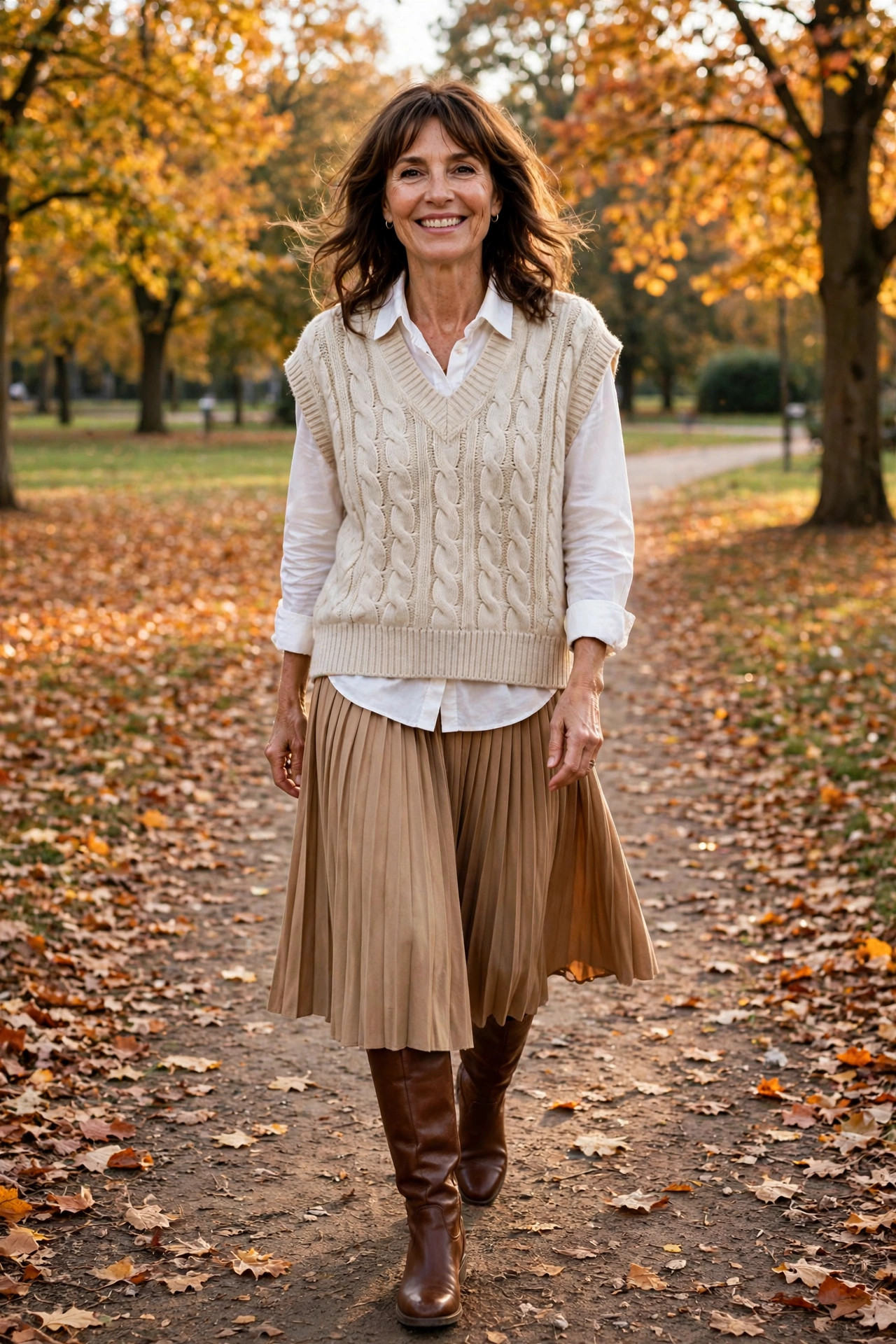
| Chunky cable knit | Thin base layer only, to avoid bulk | Jeans and boots, or a midi skirt | Cozy fall staple |
| Fine-knit V-neck | Collared shirt with the collar showing | Tailored trousers, under a blazer | Refined, layered professional |
Fit notes that matter in the fitting room:
- Armhole depth is the comfort test. Raise your arms; if the base layer bunches or the vest pulls, size up or choose a vest with deeper armholes.
- Length decides the tuck. A vest that ends at or above the waistband works untucked over high-rise bottoms. A longer vest looks better with the base layer tucked in so the hemline stays clean.
- Knit thickness decides the season. Fine knits layer under blazers and coats. Chunky knits are outer layers on their own and pair best with thin base layers.
Step 2: What to Wear Under a Sweater Vest
The base layer is doing two jobs: comfort against the skin and the visible detail at the neck, collar, and sleeves. Here are the options that work, from most formal to most casual.
The crisp button-down shirt
The classic pairing, and still the easiest way to look put-together. A white or light blue shirt under a neutral vest works for the office, meetings, and any day you want to look intentional with zero effort. Keep the shirt fitted through the shoulders so it lies flat, tuck it in fully, and let the collar sit neatly over the vest neckline. V-neck vests show off the collar best; crew necks hide it for a cleaner, more casual line.
Formula: fitted button-down + classic fitted vest + tailored trousers + loafers = the preppy office outfit.
The fitted turtleneck
When temperatures drop, a thin turtleneck under a sweater vest is one of the warmest combinations that still looks slim. This is the base layer for winter dinner outfits and cold-weather weekends. Choose a turtleneck that fits close to the neck and body; a chunky turtleneck under a vest creates bulk at the shoulders. Dark vest over a light turtleneck (or the reverse) gives the sharpest contrast.
Formula: black turtleneck + cream oversized vest + straight-leg jeans + ankle boots = cozy and modern.
The plain tee or long-sleeve top
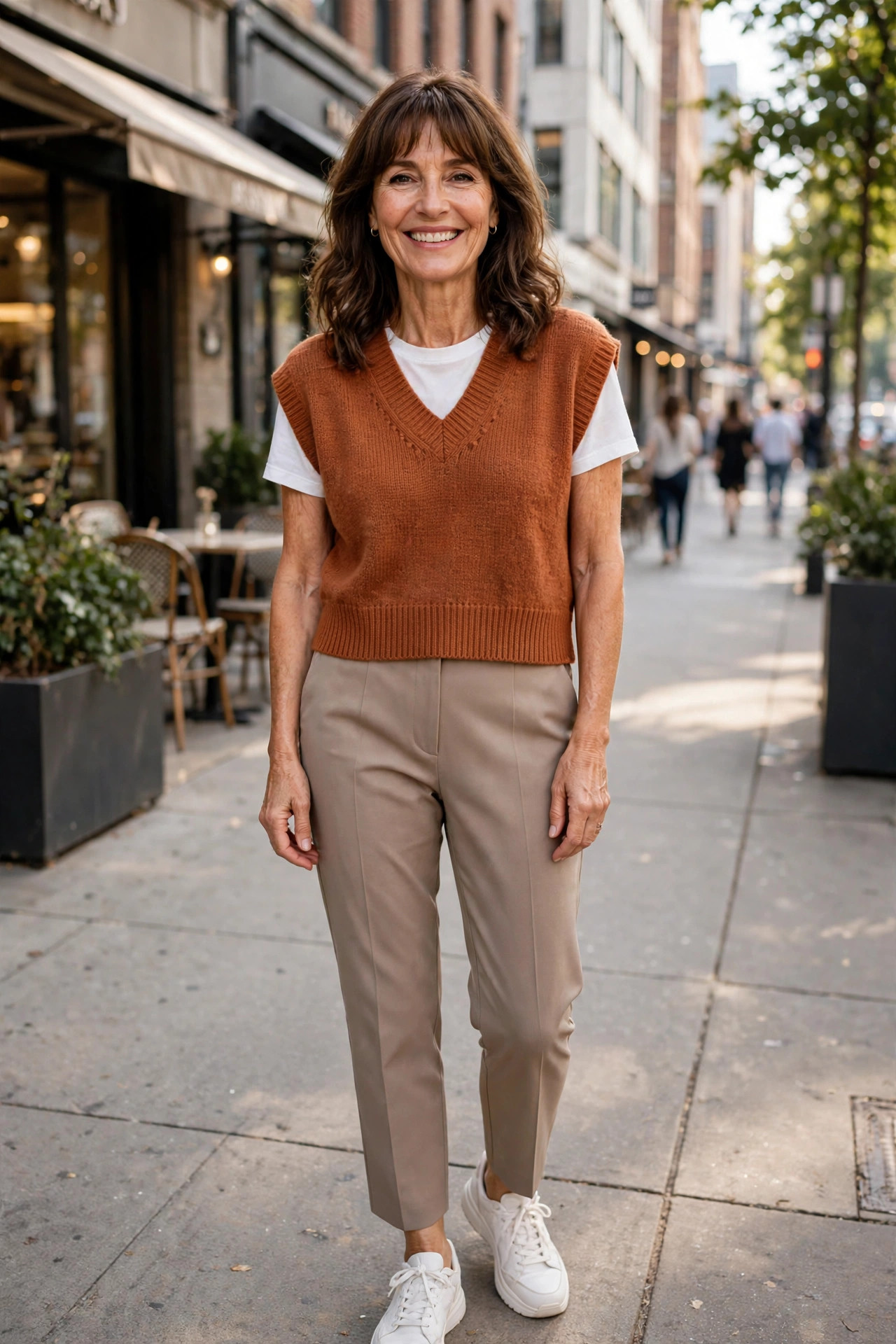
This is the move that takes the sweater vest out of preppy territory. A simple crew-neck tee or fitted long-sleeve top under a vest reads relaxed and current, especially with sneakers or chunky loafers. Roll or push the sleeves slightly for an effortless finish. Striped tees under solid vests add visual interest without any pattern-clashing risk.
Formula: striped long-sleeve tee + cropped vest + high-waisted wide-leg jeans + sneakers = weekend uniform.
The blouse or satin top
For evenings and dressier days, swap the cotton base for something with sheen. A satin or silk-look blouse under a fine-knit vest elevates the whole outfit, and the contrast between matte knit and glossy fabric looks expensive. This combination works beautifully for dinner outfits for women when you want texture without a full sweater.
Formula: satin blouse + fine-knit vest + midi skirt + heeled boots = dinner-ready texture.
Nothing at all: the vest as a top
A sweater vest worn on its own as a sleeveless top is the most modern way to wear it, and ideal for transitional weather when a full sweater is too warm. This works best with a vest that has a higher neckline and a fit that skims rather than clings. Balance a fitted vest-as-top with relaxed bottoms, or an oversized vest with a streamlined skirt or slim trousers.
Step 3: Preppy or Modern? Pick Your Direction
The sweater vest carries preppy associations, but the styling around it decides the final verdict. Here is how to steer the same vest in either direction.
Go preppy when you want polish: button-down shirt underneath, collar visible, tailored trousers or a pleated skirt, loafers or ballet flats, minimal jewelry. Keep the color palette classic: navy, cream, camel, forest green, burgundy. Argyle and cable-knit patterns lean preppy on their own, so pair them with simple, modern bottoms to keep the look from tipping into costume.
Go modern when you want edge: plain tee or turtleneck underneath, oversized or cropped fit, wide-leg or baggy jeans, sneakers or chunky boots, one bold accessory. Solid colors and unexpected pairings (a vest with cargo pants, a vest over a slip dress) break the school-uniform association fast.
The one-swap rule: if an outfit feels too preppy, change exactly one element. Swap the button-down for a plain tee, or the loafers for sneakers, or the pleated skirt for straight-leg jeans. One swap is usually enough to shift the whole mood.
How to Layer a Sweater Vest Under a Blazer
The vest-under-blazer combination is the secret weapon of cold-weather dressing: three visible layers of texture with almost no bulk. It works because a fine-knit vest sits flat between a shirt and a jacket.
The order: fitted shirt closest to the body, fine-knit vest in the middle, blazer on top. Keep the vest thin; a chunky knit under a blazer strains the shoulders and ruins the jacket line.
The neckline math: a V-neck vest under a blazer shows a neat triangle of shirt and tie-free collar, which reads sharp and intentional. A crew-neck vest under a blazer hides the layering, so the effect is just added warmth and a hint of knit texture at the hem.
The bottom half: tailored trousers or dark jeans keep the look coherent. This is also a strong formula for fall dinner outfits for women when the evening calls for a jacket but you want more personality than a plain shirt.
Sweater Vest Outfits by Season
Fall: the vest’s home turf
Fall is when the sweater vest earns its keep. Layer a vest over a long-sleeve tee or light turtleneck with jeans and boots, and you have a uniform for the whole season. Rich colors like burgundy, chocolate, olive, and rust make a neutral vest feel seasonal, and a vest over a midi dress with tights extends your summer dresses into October. A cropped vest over a longer button-down with the shirttail showing is a fresh proportion trick for fall.
Winter: warmth without bulk
In winter, the vest becomes a mid-layer. Wear it over a fitted turtleneck and under a wool coat or puffer, and your torso stays warm while your arms keep full movement. Darker, denser knits look right in winter light. Pair with tailored trousers or dark jeans and knee-high boots for a streamlined cold-weather silhouette.
Spring: the transitional layer
Spring is the vest-as-top season. Wear it sleeveless over high-waisted trousers or a midi skirt on mild days, or over a light long-sleeve top when mornings are still chilly. Lighter colors and cotton or cotton-blend knits suit spring better than heavy wool.
Summer evenings: yes, really
On cool summer evenings, a lightweight cotton vest over a sundress or a simple tank adds just enough warmth without committing to a jacket. If you live for sundress outfits, a cropped vest in a complementary color is an easy way to restyle a dress you have worn all season.

Proportion Rules That Prevent Styling Mistakes
Most sweater vest outfits go wrong in one of three ways, and all three are fixable in seconds.
Mistake 1: bulk on bulk. A thick vest over a thick sweater, or an oversized vest over a baggy hoodie, hides your shape entirely. Fix: one structured or fitted layer per outfit. Chunky vest? Thin base layer. Oversized vest? Slim bottom.
Mistake 2: the awkward hemline. A vest that ends mid-hip over low-rise bottoms chops the torso visually. Fix: match vest length to your rise. Cropped vests love high-waisted bottoms; longer vests work when the base layer is tucked and the bottom is streamlined.
Mistake 3: pattern overload. Argyle vest plus striped shirt plus plaid trousers is a lot. Fix: one pattern per outfit. Let a patterned vest be the star with solid pieces everywhere else, or keep the vest solid and let one other piece carry the print.
Building a Sweater Vest Capsule: 3 Vests, 12 Outfits
You do not need a drawer full of vests. Three cover nearly every situation:
- A neutral fine-knit V-neck (cream, navy, or camel): the office and evening vest. Wears under blazers, over button-downs and blouses.
- A relaxed or oversized solid vest (gray, olive, or chocolate): the weekend vest. Wears over tees and turtlenecks with jeans.
- One personality vest (cropped, argyle, cable-knit, or a rich color like burgundy): the statement vest for nothing-to-wear mornings when a plain outfit needs one interesting piece.
Rotate the base layers and bottoms around these three and you have two weeks of distinct outfits. This is also the most budget-friendly way into the trend: the vest does the visual work, so the pieces underneath can be basics you already own.
Sweater Vests for Every Body
Fit flexibility is where the sweater vest quietly wins. A few guidelines:
- Petite frames: cropped or fitted vests keep proportions in scale; avoid oversized knits that swallow the torso.
- Curvy figures: vests with a touch of stretch skim rather than cling; pair with high-waisted bottoms to define the waist, and a V-neckline elongates the neck.
- Tall frames: longer, relaxed vests look proportional; a cropped vest can work too when the bottom is high-waisted.
- Plus-size styling: the same three-part system applies, with attention to armhole comfort and shoulder fit. For more fit-first guidance, see plus-size dinner outfits for ladies, where the same balance principles show up in evening looks.
The universal rule: the vest should skim, not squeeze. If it pulls at the buttons or the armholes dig in, size up. Comfort reads as confidence.
Frequently Asked Questions
Can you wear a sweater vest without a shirt underneath?
Yes. Wearing the vest on its own as a sleeveless top is one of the most modern ways to style it. Choose a vest with a higher neckline and a fit that skims the body rather than clinging, and balance it with relaxed bottoms like wide-leg trousers or a flowy skirt. This works best in transitional weather when a full sweater would be too warm.
What do you wear under a sweater vest?
The five reliable options are a crisp button-down shirt for polish, a fitted turtleneck for warmth, a plain tee or long-sleeve top for casual days, a satin or silk blouse for evenings, and nothing at all for a modern sleeveless-top look. Match the base layer weight to the vest: thin bases under fine knits, and never a bulky layer under a chunky vest.
Are sweater vests still in style for 2026?
Yes. The sweater vest has moved past trend status into wardrobe-staple territory, showing up in preppy, streetwear, and minimalist outfits alike. What keeps it current in 2026 is the styling around it: modern fits like cropped and oversized, unexpected pairings with wide-leg jeans or slip dresses, and wearing it as a standalone top. Styled deliberately, it reads fresh rather than retro.
Can I wear a sweater vest to the office?
Absolutely, with the right formula. Choose a fine-knit vest in a neutral color, layer it over a crisp button-down shirt with the collar neat, and pair it with tailored trousers or a pencil skirt. For conservative workplaces, keep the palette classic and add a blazer on top. Skip chunky knits, loud patterns, and oversized fits for the office, and save those for weekends.
Conclusion
A sweater vest is not a costume piece and not a one-note trend. It is a layering system: base layer, vest fit, balanced bottom. Learn the three-part formula, pick the fit that matches your mood, and steer preppy or modern with one-swap adjustments. Three vests and the basics you already own are enough to build two weeks of outfits, from office polish to weekend ease to dinner-ready texture.

Rameen Awan is the founder and editor of Outfit Algorithm, where she breaks down outfit formulas, dress codes, and styling systems for real life. Her guides focus on practical details other sites skip: fabric behavior, fit for different body types, and what actually works when you are getting dressed in a hurry.