
Pants for small waist and big thighs are the hardest fit problem in a wardrobe. The pants that fit your thighs gape at the waist, and the pants that fit your waist will not button over your thighs. It is not a sizing mistake and it is not your body. Standard pants are graded for one waist-to-hip ratio, and if your ratio is wider than that pattern, no size on the rack will fit both places at once. This guide explains why the waist gap happens, which cuts fix it, and how a tailor finishes the job when the rack gets close but not perfect.
The short version: buy for your hips and thighs first, then fix the waist. Look for curvy-fit cuts, which are graded with a smaller waist and a wider hip, in a high rise with 1 to 3 percent stretch and a contoured waistband. If the waist still gaps by an inch or two, a tailor can take it in for a typical $20 to $50. That two-step method, fit the thighs first and fix the waist second, solves the problem for nearly every body that has it.
Why Do Pants Gap at the Waist?
A waist gap is the space between the waistband and your lower back when the rest of the pants fit. It happens because ready-to-wear pants are cut to a standard waist-to-hip difference of about 10 inches. If the difference between your waist and your hips is 12 or 13 inches, the size that fits your hips will always be too big at the waist, and the size that fits your waist will always be too tight through the hips and thighs.
The gap is a pattern problem, not a body problem. Most brands grade every size up from one sample size, so the waist-to-hip ratio stays the same across the whole size run. A woman with a 27-inch waist and 40-inch hips needs a 13-inch difference, and the standard pattern only gives her 10. Sizing up fixes the thighs and creates the gap. Sizing down fixes the waist and creates pulling, creasing, and a waistband that digs in when you sit.
Muscular thighs make the same problem sharper. Thighs built by cycling, running, lifting, or dancing need more room through the leg than the standard pattern allows, even when the hips measure average. The Reddit threads that sparked this guide say the same thing three ways: pants that fit the waist will not pull over the thighs, and pants that fit the thighs gape at the waist. The fix is the same in every case, and it starts with measuring.
Measure Your Waist-to-Hip Difference in 2 Minutes
Before you shop, measure two numbers. Stand straight, breathe out naturally, and wrap a soft tape around your waist at its narrowest point, usually just above the belly button. Then measure your hips at their fullest point, around the widest part of your seat and thighs, keeping the tape level. Subtract the waist number from the hip number. That difference is the number that decides which pants will fit you.
| Waist-to-hip difference | What it means | What to buy |
|---|---|---|
| 9 to 10 inches | Close to the standard pattern | Standard cuts usually work, with stretch helping |
| 11 to 12 inches | Starting to outgrow the standard pattern | Curvy-fit cuts, high rise, contoured waistband |
| 13 inches or more | Well outside the standard pattern | Curvy fit plus a tailor, or curvy fit in stretch fabrics |
Measure over thin clothing or underwear, not over jeans, and measure twice. Waist size changes through the day by a little, so measure in the morning and again in the evening and use the larger number. Write the two numbers in your phone before you shop, because size charts list waist and hip separately and the difference is what you are actually shopping for. If the difference is 12 inches or more, skip the standard cut entirely and go straight to the curvy-fit section below.
The Curvy-Fit System: Which Cuts Actually Work
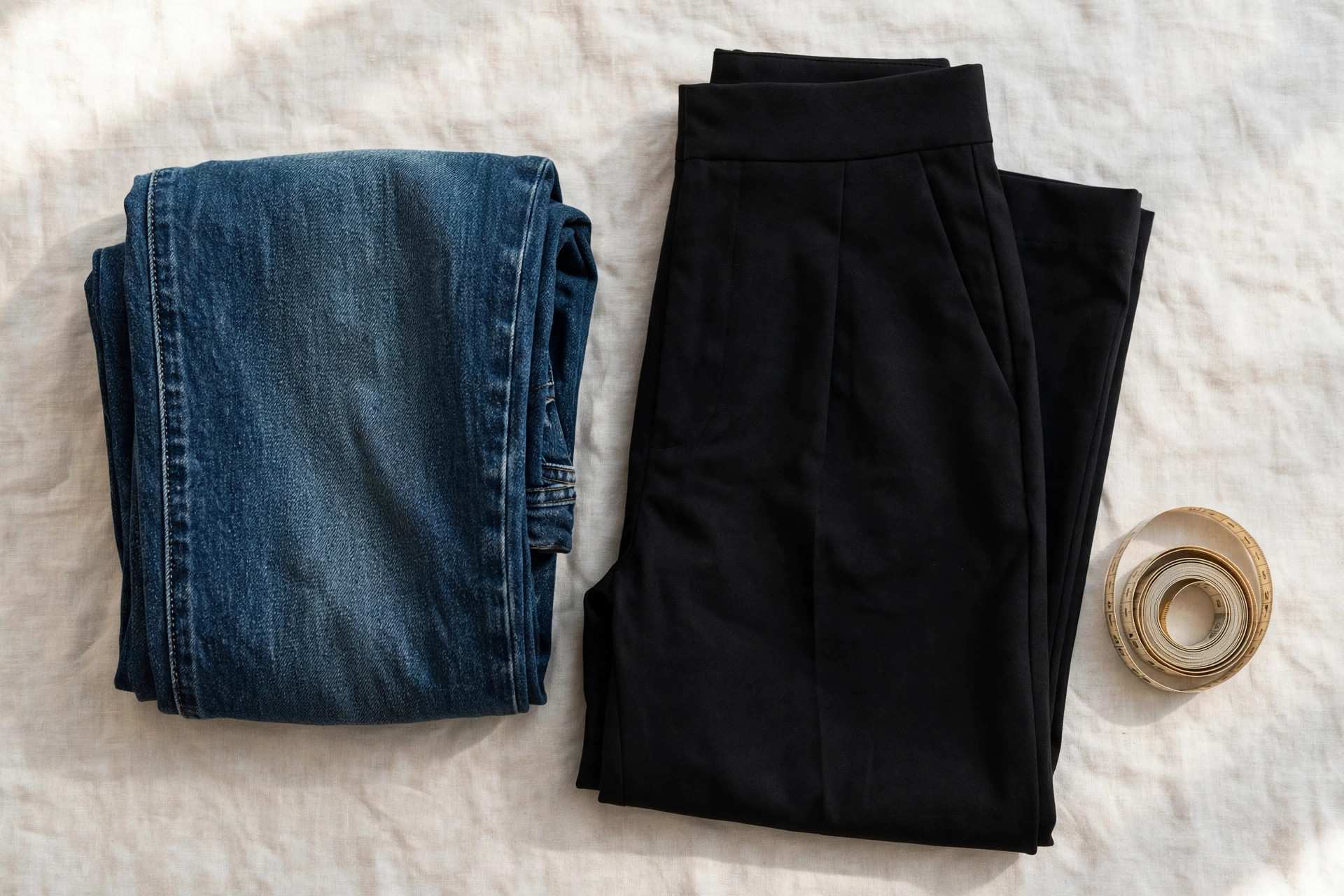
Curvy fit is not a marketing word. It is a different pattern, graded with a smaller waist and more room through the hip, seat, and thigh. The best-known curvy-fit lines, Abercrombie Curve Love, Madewell Curvy, American Eagle Curvy, and Good American, all cut the same way: the waistband is shaped to curve in, the rise is a little longer, and the thigh has more room than the standard version of the same size. American Eagle lists its curvy cut at a 13-inch hip-to-waist difference, against about 10 inches for its standard cut, which is exactly the gap this guide is about.
For a fuller picture of how the cuts compare, the Stylisteer guide to dressing big hips and a small waist walks through the same high-rise, curvy-fit, and contoured-waistband logic with its own FAQ set. The cuts below are the ones that hold up across brands, not one brand’s naming.
| Cut | Why it works | Watch out for |
|---|---|---|
| Curvy-fit straight leg | Smaller waist, more thigh room, clean line from hip to ankle | Some curvy cuts run short in the rise, so check the rise measurement |
| High-rise wide leg | High rise sits at the narrowest waist, wide leg gives thighs room | Needs a contoured waistband, or the wide leg still gaps at the back |
| Curvy-fit bootcut or flare | Flare from the knee balances the hip line and lengthens the leg | Very long flares need hemming, which adds cost |
| High-rise mom jeans | Tapered leg with room at the thigh, waist sits at the natural waist | Rigid mom jeans with no stretch will not forgive a tight thigh |
Three details matter more than the cut name. First, the waistband should be contoured, meaning it curves in at the back instead of running straight across. A straight waistband on a curvy body will always gap at the center back. Second, the rise should be high or mid-high, sitting at or just above your natural waist, because a low rise sits on the hip and slides down. Third, the fabric should have 1 to 3 percent elastane or lycra. That small amount of stretch lets the thigh move without pulling the waistband open. Avoid fabrics with more than 4 percent stretch, because they lose their shape by the afternoon and the waistband goes loose.
How to Shop for Pants That Fit Both Places
Shop by your hip measurement, not your waist measurement, and not the size you think you wear. Find your hip number on the size chart first, then check whether that size’s waist is within about 2 inches of your waist. If it is, the pants are a tailor candidate. If the waist is more than 2 inches too big, the take-in gets expensive and the pockets start to move, so try a curvier cut instead. This one rule saves more returns than any other.
Run these four checks in the fitting room. First, the sit test: sit down, cross your legs, and stand up. The waistband should stay where you put it and the thigh should not pull tight across the front. Second, the squat test: squat halfway and stand. If the waistband slides down your back, the rise is too low or the waist is too big. Third, the two-finger test: slide two fingers flat under the waistband at the back. If more than two fingers fit, the gap is too big for a belt to fix honestly. Fourth, the pocket test: side pockets should lie flat. Pockets that gape open mean the hip is too tight, even if the waist feels fine. The winter tights fit guide uses the same sit-test logic for a different garment, and the principle is identical: fit is proven sitting down, not standing still.
Build a small rotation instead of buying one perfect pair. Three pairs cover nearly every week: one dark straight-leg pair in a curvy fit for work and polished days, one wide-leg pair in a fluid fabric for comfort and evenings, and one pair of curvy-fit jeans for everyday wear. The capsule wardrobe guide shows how three bottoms inside one color palette turn into dozens of outfits, and pants that actually fit are the right bottoms to build around.
The Tailor Fix: Taking In the Waist
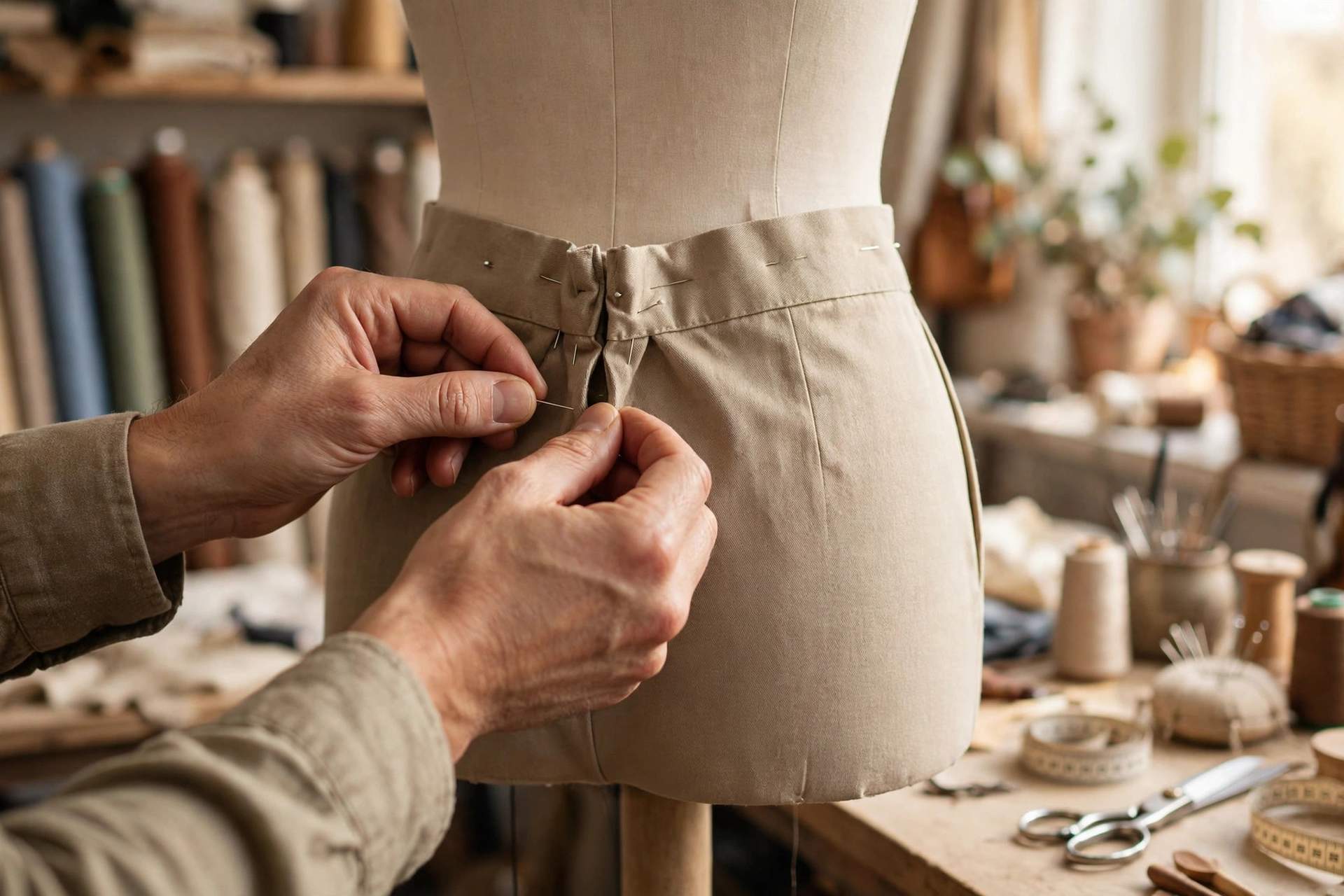
When curvy fit gets you close but the waistband still gaps by an inch or two, a tailor finishes the job. Taking in the waist is one of the simplest and cheapest alterations, and it turns a good hip fit into a clean overall fit. Buy the pants that fit your hips and thighs, then take them to a tailor instead of returning them.
A basic waist take-in typically costs $20 to $50, depending on the city, the fabric, and how much needs to come in. Jeans and lined trousers usually cost more than plain cotton pants, because denim needs heavier equipment and lined trousers mean sewing two layers. Ask for a quote before the tailor starts, and bring the shoes and top you plan to wear with the pants so the fitting is done the way you will actually wear them.
Ask the tailor to take in the center back seam first, because that is where most of the gap lives and it keeps the side pockets where they belong. A standard waistband can usually be taken in 1 to 2 inches at the back seam and another half inch to 1 inch at each side seam, which covers the majority of waist gaps. If the gap is bigger than about 3 inches total, say so at the fitting, because the tailor may need to move the pockets or add darts, and that costs more. Tell the tailor the exact words: take in the waist at the center back, keep the hip and thigh exactly as they are, and do not taper the leg.
What a tailor cannot fix is a hip that is too tight. Letting a waistband out is limited by the seam allowance the manufacturer left inside, and many budget brands leave almost nothing. So the rule never changes: fit the thighs first, then fix the waist. A tailor can also shorten the hem while the pants are in, which is worth doing in the same visit if the length is off, since you are already paying for the fitting.
Petite Fit Notes: Small Frame, Muscular Thighs
Petite women with muscular thighs face the waist gap twice, once for the ratio and once for the length. A petite inseam with a standard waist-to-hip ratio is already hard to find, and adding thigh room makes the standard petite cut gap at the waist too. The fix is to shop curvy fit in a petite length, not standard fit in a petite length. Madewell Curvy and Abercrombie Curve Love both offer short lengths, which solves the length and the ratio in one pair.
If no curvy petite option exists in the style you want, buy the curvy regular length that fits your hips and have the hem shortened. Hemming is cheaper than a waist take-in, and it is a simpler alteration. For the jeans-specific version of this problem, inseam, rise, and cut, the best jeans for petite women guide walks through the same measurements with the denim details. This guide covers all pants and the waist gap itself, and the petite jeans guide covers the denim version.
Plus-Size Fit Notes
Plus-size pants carry the same waist-gap problem with a wider range of solutions. Curvy-fit lines run into plus sizes at Good American, which goes to size 32, and Madewell Curvy, which offers plus sizing alongside petite and tall. Universal Standard and Eloquii are strong for work trousers and polished wide-leg styles with thoughtful waistband shaping, and Lane Bryant covers sizes 10 to 40 with petite and tall options.
Two details matter more at plus sizes. First, the rise should be genuinely high, sitting at the natural waist, because a mid rise on a fuller hip slides down and creates a gap at the back when you sit. Second, a wide-leg or straight-leg cut flatters more reliably than a skinny cut, because the leg falls cleanly from the hip instead of clinging to the thigh and pulling the waistband. For the formal version of this fit logic, the plus-size work award ceremony outfits guide covers dress-code decoding and fit-first styling for occasions where the pants have to look polished all evening.
5 Mistakes That Make the Waist Gap Worse
- Sizing down to fit the waist: the waist feels right in the store and the thighs pull, crease, and wear out faster. Size for the thighs and fix the waist after.
- Buying rigid fabric with no stretch: 100 percent cotton with no elastane has no forgiveness at the thigh, so the waistband takes all the strain. Look for 1 to 3 percent stretch.
- Choosing a low rise: a low rise sits on the hip instead of the waist, so it slides down when you sit and the gap opens at the back. High rise holds the waistband where it belongs.
- Using a belt as the fix: a belt gathers the extra waistband into folds at the back, which reads as a fit problem from behind. A belt is for styling, not for holding up pants that do not fit.
- Picking skinny cuts for strong thighs: a skinny leg clings to the thigh and pulls the waistband down and open. A straight or wide leg lets the thigh move without dragging the waist with it.
Frequently Asked Questions
What are the best pants for someone with big hips and a small waist?
High-rise wide-leg, curvy-fit straight-leg, and bootcut pants work best. Choose styles with enough hip and seat room plus a contoured or shaped waistband that sits securely at your smaller waist. Curvy-fit lines are graded with a smaller waist and a wider hip, which is the pattern difference that actually solves the problem.
What jeans are best for big hips and a small waist?
Curvy-fit straight-leg, high-rise bootcut, and high-rise flare jeans are worth trying first. Prioritize a smaller waist-to-hip ratio, enough room through the seat and thighs, and a waistband that does not gape. Look for 1 to 3 percent elastane in the denim so the thigh has give without the waistband going loose.
How do you stop pants from gaping at the waist with big hips?
Start with curvy-fit pants or jeans designed with a smaller waist-to-hip ratio. If the hips fit but the waistband still gaps, a simple waist alteration can create a much cleaner fit. A tailor takes in the center back seam, usually 1 to 2 inches, for a typical $20 to $50, and that closes the gap without touching the hip fit.
Can a tailor take in the waist of jeans?
Yes. Taking in the waist of jeans is a routine alteration, and most tailors do it easily. Ask for the waist to be taken in at the center back seam while the hip and thigh stay exactly as they are. Jeans usually cost a little more than plain trousers because denim needs heavier equipment, so ask for the price before the tailor starts.
What jeans are best for big thighs?
Wide-leg, straight-leg, and curvy-fit jeans are the most comfortable, because they give the thigh room without pulling the waistband open. Look for high-rise cuts with stretch denim and a contoured waistband. Avoid rigid skinny jeans with no stretch, which fit the thigh by force and gap at the waist as soon as you sit.
How much does it cost to take in the waist of pants?
A basic waist take-in typically costs $20 to $50 in the US, depending on the city and the fabric. Jeans, lined trousers, and embellished pants cost more, and a take-in bigger than about 3 inches total can cost more because the tailor may need to move pockets or add darts. Always ask for a quote at the fitting before the work starts.
Conclusion: Key Takeaways
Pants for small waist and big thighs come down to three decisions in order: measure the difference, buy for the thighs, and fix the waist. Measure your waist and hips and note the difference, because that number tells you whether standard cuts can work at all. Buy curvy-fit pants in a high rise with a contoured waistband and 1 to 3 percent stretch, sized to your hips. If the waist still gaps by an inch or two, a tailor takes it in at the center back for a typical $20 to $50. Get those three right and the waist gap stops being a shopping problem. For the wide-leg styles that work best with this fit, the how to style wide-leg pants guide covers the styling side once the fit is solved.

Rameen Awan is the founder and editor of Outfit Algorithm, where she breaks down outfit formulas, dress codes, and styling systems for real life. Her guides focus on practical details other sites skip: fabric behavior, fit for different body types, and what actually works when you are getting dressed in a hurry.