
If you are 5’4″ or under, the best jeans for petite women are rarely waiting on the regular rack. Standard jeans are patterned for a taller frame, so the knee lands below your knee, the rise climbs past your natural waist, and the hem pools over your shoes. Hemming fixes only the last of those three problems.
Petite sizing works differently. A true petite jean is re-proportioned from the pattern up, with a shorter rise, a higher knee position, back pockets placed higher and scaled smaller, and a shorter inseam. This guide walks through how to judge each of those four things, how to work out your inseam from a pair you already own, which cuts suit which petite silhouette, and where genuinely petite-sized jeans stay under $80.
The Short Answer: Fit Is Proportion, Not Just Length
For most petite women, the fastest route to a good fit is a petite-specific pair in a mid or high rise, with an inseam of 25 to 28 inches for a full-length style and 24 to 26 inches for an ankle style. Straight-leg and slim straight cuts are the most forgiving place to start, because they follow the leg without adding volume a small frame has to carry.
If you remember one rule, make it this one: measure the jeans, not the label. Two pairs both marked “petite” can differ by two inches in the rise and an inch in the inseam, and those differences are exactly the ones you feel all day.

Why Do Regular Jeans Fit Petites So Badly?
Regular jeans fail petites in four places, and only one of them is length. Petite sizing is clothing cut for women 5’4″ and under, scaled in the rise, the knee placement, and the pocket position as well as the inseam. A pair sold as “short” is usually a regular pattern with the leg chopped, and that distinction explains most fitting room frustration.
The knee lands in the wrong place. On a regular pattern, the knee of the jean sits an inch or more below your actual knee. The fabric then creases and wrinkles at the wrong point, and any shaping built into the leg, such as the start of a flare, begins too low. True petite patterns raise the knee so the leg hangs straight.
The rise overshoots your torso. A regular high rise can measure 12 inches or more. On a short torso, that waistband reaches the ribcage, digs in when you sit, and swallows the waist definition the style was supposed to create.
The back pockets sit too low. Pockets patterned for a taller frame land low on the seat and make legs look shorter than they are. Petite patterns move the pockets up and scale them down, which lifts the whole back view.
The same scaling logic runs through every category, not just denim. Our guide to petite winter coats shows the identical pattern problem in outerwear, where a regular cut adds length in the body and sleeves instead of re-proportioning the whole garment.
What Rise Works Best on a Short Torso?
The rise is the distance from the crotch seam to the top of the waistband, and it decides where the jeans sit on your torso. It is the single measurement that most changes how tall you look, because it sets the point where your legs appear to start. A higher rise moves that point up and lengthens the leg line. A lower rise drops it and gives the torso more visual share.
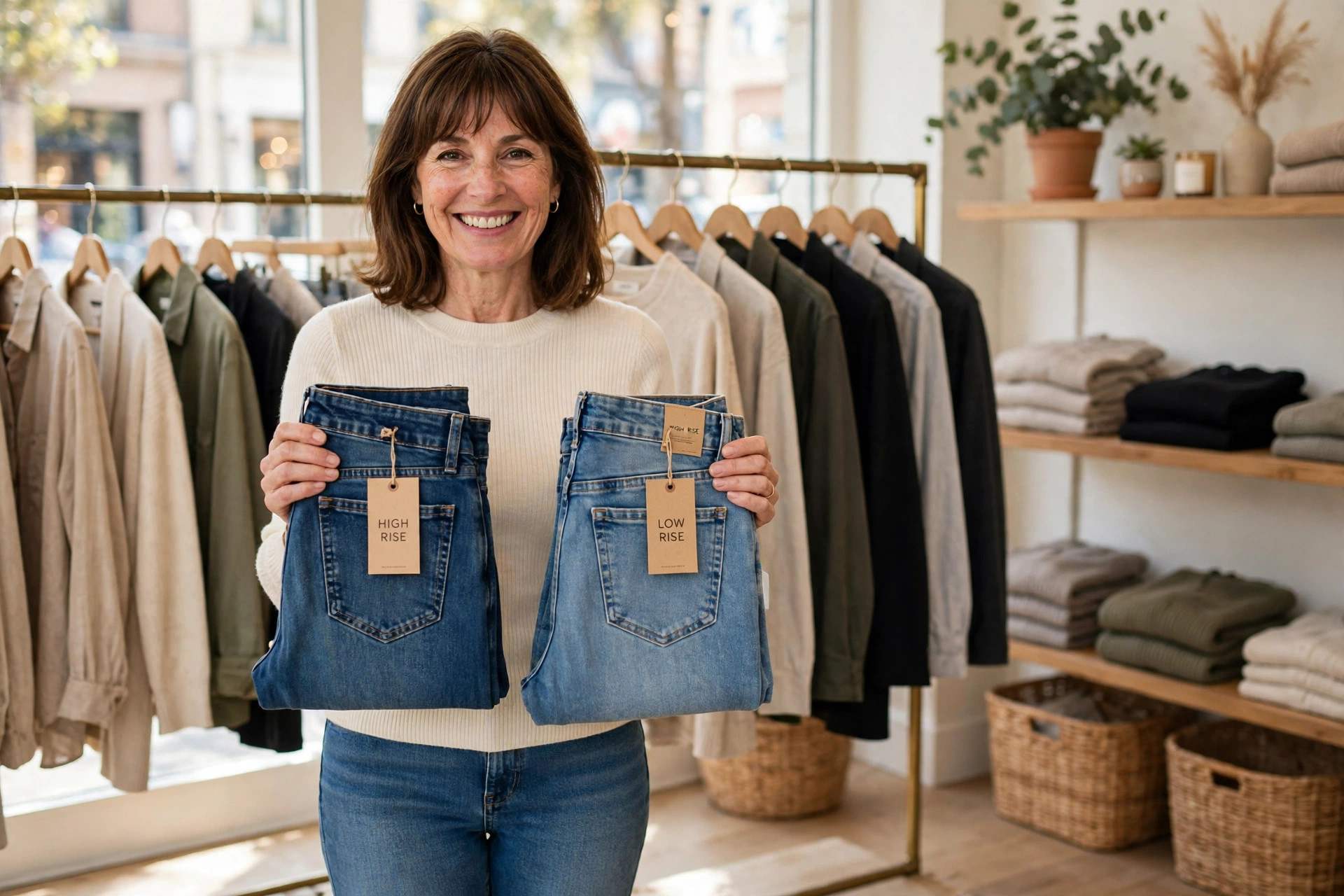
Your torso length matters as much as your height. Sit down and note the gap between the bottom of your ribs and the top of your hip bones. If that gap is small, roughly a hand’s width or less, you have a short torso, and a very high rise will crowd it. If the gap is generous, you can carry a higher rise comfortably. Rise is also the biggest lever in balancing your proportions overall, because it redraws the line between your top half and your bottom half.
| Torso type | Rise to look for | Typical front rise | Why it works |
|---|---|---|---|
| Short torso | Mid rise to moderate high rise | 9 to 10.5 inches | Defines the waist without the waistband reaching the ribs or folding when you sit |
| Balanced torso | High rise | 10 to 11 inches | Sits at the natural waist, lengthens the leg line, holds tucked tops in place |
| Long torso | High rise to extra high rise | 11 to 12 inches | Shortens a long torso visually and gives short legs the longest possible line |
| Long torso, relaxed fit | Low rise | 7 to 8.5 inches | Works only when the torso can spare the length; see the low-rise notes below |
Two fit checks apply to any rise. First, the waistband should sit flat against your back with no gap you can fit more than two fingers into. Second, sit down in the fitting room. A rise that feels fine standing but cuts in when seated is the wrong rise for your torso, whatever the label says.
Can Petite Women Wear Low-Rise Jeans?
Yes, but low rise is the hardest rise for a petite frame to carry, and it helps to know why before you buy. Most fit guidance warns petites off low rise for a sound reason: dropping the waistband to the hips makes the legs look shorter and the torso longer. On a 5’1″ frame, that trade is expensive.
Plenty of petite women want the style anyway, and recent threads in r/PetiteFashionAdvice show strong demand for low-rise jeans, especially in rigid 100 percent cotton denim. If you are set on a pair, stack the odds in your favor:
- Choose a petite-cut low rise, around 7 to 8.5 inches at the front, rather than a regular low rise that also drags at the hem.
- Pick rigid or low-stretch denim. A firm waistband stays where it sits on the hip instead of sliding down through the day.
- Pair it with a straight or relaxed leg, not a skinny leg. Width at the hem balances the low waistband.
- Tuck your top in or choose a cropped length. Restoring a visible waistline gives back the leg length the low rise takes away.
- Keep the hem at the ankle or at full length. A low rise plus a mid-calf crop cuts the leg line twice.
Long-torso petites pull low rise off most easily, because their frames can spare the torso length. Short-torso petites usually find a mid rise gives the same relaxed feel with a better leg line.
How Do You Work Out Your Inseam?
The most reliable inseam number comes from a pair of jeans you already own and like the length of. Lay them flat, smooth out the leg, and measure from the crotch seam straight down to the hem. That number is your inseam for that style and that shoe height, and it transfers to any product page that lists measurements.
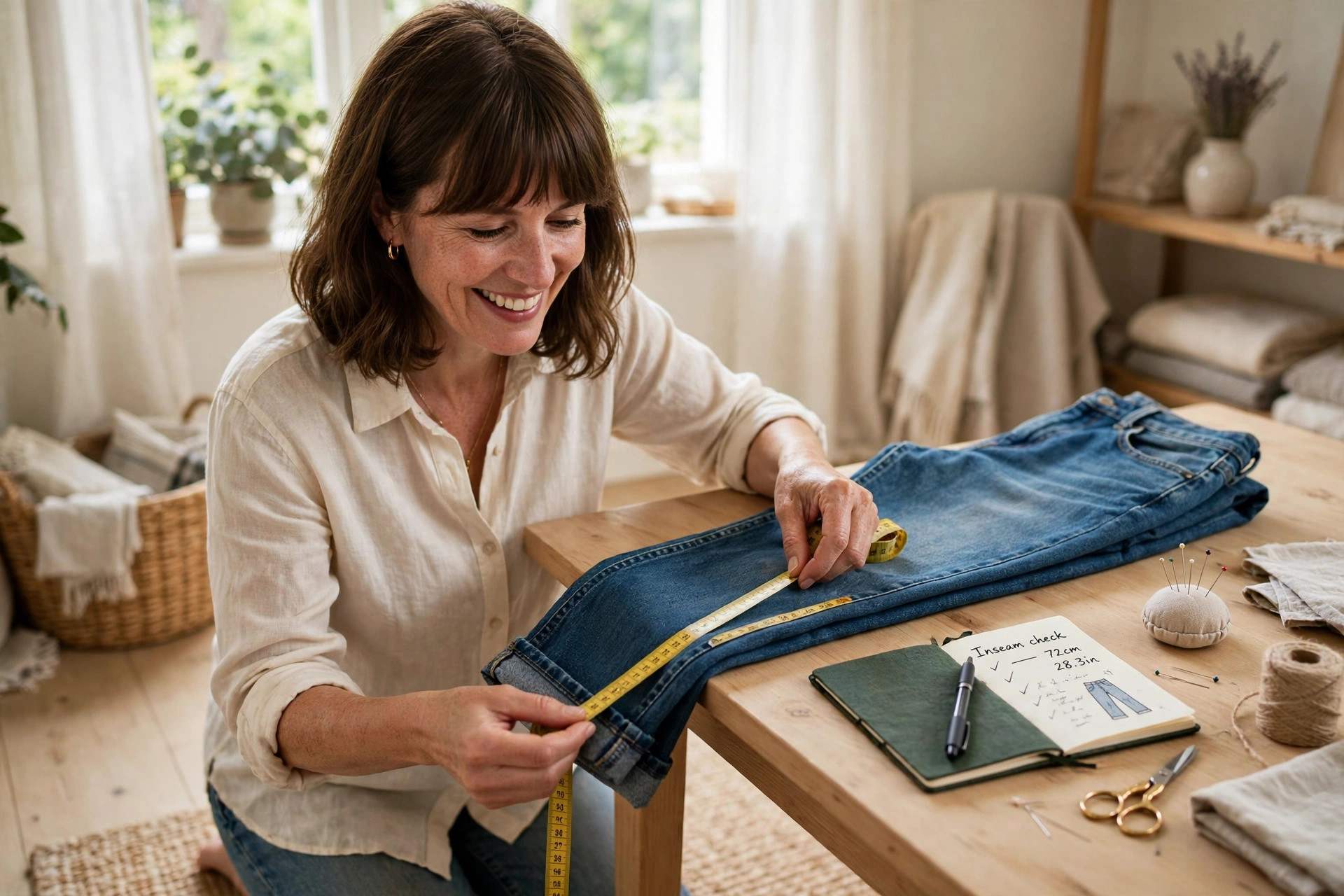
Do not own a pair you love yet? Use your height as a starting estimate, then adjust by style. Ankle styles sit 1 to 2 inches shorter than full-length styles on the same frame, and a heel lets you add roughly an inch because the hem hangs higher off the ground. NYDJ publishes a clear walkthrough of how to measure your inseam and match it to a size chart, including how petite, regular, and tall ranges differ.
| Your height | Ankle or cropped inseam | Full-length inseam (flats) | Bootcut or flare inseam (with a heel) |
|---|---|---|---|
| 4’11” to 5’1″ | 23 to 25 inches | 25 to 26 inches | 27 to 28 inches |
| 5’2″ to 5’3″ | 24 to 26 inches | 26 to 27 inches | 28 to 29 inches |
| 5’4″ | 25 to 26 inches | 27 to 28 inches | 29 to 30 inches |
One hem length deserves a specific warning. A crop that ends at mid-calf is the most shortening length on a petite leg, because it cuts the line at its widest point. Crops should end at the ankle bone, where the leg is narrowest, or not at all.
Which Cuts Flatter Which Petite Silhouette?
Every cut can work on a petite frame once the rise and inseam are right. The cut then decides where the eye lands and how much volume the outfit carries. Match the cut to your silhouette first, then style around it.
| Cut | Best for | Petite-specific notes |
|---|---|---|
| Straight leg | Most silhouettes; the safest first buy | Look for an ankle length so the clean line is not broken by bunching at the shoe |
| Slim and skinny | Straight and hourglass frames | Dark washes lengthen most; avoid extra fabric gathering at the ankle |
| Bootcut and kick flare | Pear and hourglass frames | The flare must start at your real knee, which is the strongest argument for a true petite cut; wear with a small heel |
| Wide leg | Straight frames and anyone wanting volume | Needs a fitted waist and a tucked top; a high rise keeps the leg line long. Our wide-leg pants styling guide covers the proportion rules in depth |
| Mom jeans | Straight and apple frames | Choose a tapered leg so the relaxed hip does not turn boxy; see our full guide to styling mom jeans |
| Barrel leg | Straight frames wanting shape at the hip | Pick the cropped version so the curved leg ends at the ankle, and keep the top fitted |
Two rules cut across every row of that table. Volume needs a defined waist, so any relaxed cut looks deliberate only when the waistband fits and the top is tucked or cropped. And dark, even washes lengthen more reliably than faded thighs, which draw the eye to the widest part of the leg and break the vertical line.
Where Can You Find True Petite Jeans Under $80?
Budget is rarely the real obstacle. Labeling is. Under $80, plenty of retailers sell jeans in petite ranges or in short lengths, but only some of them re-proportion the pattern. Before you order, open the product details and check three things: an inseam listed in inches, a rise listed in inches, and a size range marked petite (usually with a P) rather than a regular range with a short option only.
Retailers with genuine petite or short ranges at everyday prices include ASOS Petite, which stocks one of the largest petite denim selections online with inseams down to about 25 inches; American Eagle, whose short and extra-short lengths are a recurring recommendation in petite communities; and the petite ranges at Old Navy and Gap, plus short lengths in Target’s in-house denim lines. Core styles at these retailers are typically priced under $80, and many sit well under it during regular promotions. Premium petite labels exist too, but most of their denim starts above this budget, so they are not where an under-$80 search should begin.
One more check separates a bargain from a return. A pair that needs hemming plus a waist alteration has quietly spent the money you saved. The price-per-wear logic in our guide to looking stylish on a budget applies directly here: one pair that fits off the rack beats two pairs waiting on a tailor.
What Should You Check Before You Keep a Pair?
Run through this list in the fitting room or during the return window at home:
- Knee check: bend your leg. The jean’s knee should crease where your knee bends, not two inches below it.
- Sit test: sit down and cross your legs. The waistband should not dig in or slide down your back.
- Pocket check: back pockets should sit centered on each cheek, with the bottom edge of the pocket ending at or above the crease under the seat.
- Waistband check: no more than two fingers of gap at the back. More than that means altering or another size.
- Hem check: try the shoes you will wear most with the jeans. The hem should clear the ground without pooling, or end right at the ankle bone for ankle styles.
- Fabric check: rigid denim softens with wear but holds its shape; high-stretch denim feels easy on day one and can bag at the knee by month two.
Frequently Asked Questions
What inseam should a petite woman wear?
Most petite women wear a 25 to 28 inch inseam for full-length jeans and 24 to 26 inches for ankle styles. Your height narrows it further: around 25 to 26 inches at 5’0″, and 27 to 28 inches at 5’4″. The surest method is measuring a pair you already own that ends exactly where you want.
Are high-waisted jeans better for petites?
Usually, yes. A high rise raises the point where the legs appear to start, which lengthens the leg line on a short frame. The exception is a short torso: if the space between your ribs and hip bones is small, a moderate high rise around 9.5 to 10.5 inches flatters more than an extra-high rise that crowds the ribs.
Should petites wear mom jeans?
Yes, with two conditions. Choose a mom jean in a petite cut so the high rise matches a short torso, and look for a tapered leg that narrows toward the ankle. A straight, untapered leg in a relaxed fit can read boxy on a small frame.
Can petite women wear low-rise jeans?
They can, and the style is in demand again, but low rise is the least leg-lengthening option for a petite frame. It works best on longer torsos, in rigid denim that holds its place on the hip, with a straight or relaxed leg and a tucked or cropped top to restore the waistline.
What jeans should petite women avoid?
The recurring problems are regular-length jeans with a low knee placement, mid-calf crops that cut the leg at its widest point, very oversized fits with no defined waist, and any hem that bunches or drags. None of these are about the style itself; each is a proportion problem that a petite cut or a different hem length fixes.
Where can I find petite jeans under $80?
Start with the petite ranges at ASOS, Old Navy, and Gap, and the short and extra-short lengths at American Eagle and Target. Check the listed inseam and rise before ordering, and favor a pair marked petite over a regular pair in a short length, because the petite version is proportioned through the rise, knee, and pockets as well.
Key Takeaways
- Petite jeans are re-proportioned in the rise, knee, and pockets. A “short” regular pair is only shorter, which is why it still fits badly.
- Match the rise to your torso: short torsos suit a 9 to 10.5 inch rise, balanced torsos a 10 to 11 inch rise, long torsos 11 inches and up.
- Work out your inseam from a pair you already own. Most petites land between 25 and 28 inches full length, 24 to 26 at the ankle.
- Low-rise jeans can work on petites with a petite cut, rigid denim, a straight or relaxed leg, and a tucked top.
- True petite jeans under $80 are easy to find at ASOS Petite, American Eagle, Old Navy, Gap, and Target, as long as you check the listed inseam and rise before buying.
- Straight-leg and slim straight cuts are the most forgiving starting point; add volume cuts like wide leg and barrel only with a fitted waist.

Rameen Awan is the founder and editor of Outfit Algorithm, where she breaks down outfit formulas, dress codes, and styling systems for real life. Her guides focus on practical details other sites skip: fabric behavior, fit for different body types, and what actually works when you are getting dressed in a hurry.