

A white tie invitation is the rarest one a woman can receive, and the least forgiving. White tie dress code is the most formal dress code there is: stricter than black tie, with rules that have barely changed in a century. It appears at state dinners, royal balls, and a small number of grand ceremonies and weddings, and it asks for one specific outfit: a full-length ball gown, finished with fine jewelry and, traditionally, long gloves. There is no flexible version of this code and no short-dress workaround. This guide explains exactly what white tie demands, where the black tie rules stop working, and how to put the outfit together piece by piece.
The short version: wear a full-length ball gown that brushes the floor, in silk, satin, velvet, or taffeta, with an elegant updo, fine jewelry, and a small evening clutch. Add long gloves if the gown is sleeveless or strapless. Skip cocktail dresses, ankle-length gowns, and pantsuits: none of them meet this code. When in doubt, choose the grander gown, because at white tie there is almost no way to overdress.
What Does White Tie Dress Code Mean?
White tie is the top of the formality ladder: full evening dress, worn after 6 in the evening, with every element at its most formal. On the casual-to-formal scale it sits at 7 out of 7. Casual is 1, smart casual 2, business casual 3, cocktail 5, black tie 6, and white tie 7. The name comes from the men’s side of the code: a black tailcoat worn with a white bow tie and a white waistcoat. For women, the matching standard is a full-length ball gown with formal finishing pieces. The Emily Post Institute’s attire guide from casual to white tie puts white tie at the head of the list, above black tie, for the most ceremonial occasions.
White tie still appears in a short list of settings: state dinners and diplomatic banquets, the Vienna Opera Ball, the Nobel Prize ceremony in Stockholm, royal household events, debutante balls, and a small number of very formal weddings. If an invitation says white tie, the host chose the word deliberately. Hosts who want a slightly softer evening write black tie instead, so read white tie as an instruction, not a suggestion.
The most common misunderstanding is that white tie means a dressier version of black tie. It does not. Black tie allows a range of gown lengths, and a formal cocktail dress can pass at some events; white tie allows one length only, and expects the full ceremonial finish of gloves, fine jewelry, and dressed hair. The confusing wedding dress codes decoded guide shows where white tie sits next to every other code named on an invitation.
What to Wear to a White Tie Event: The Main Outfit
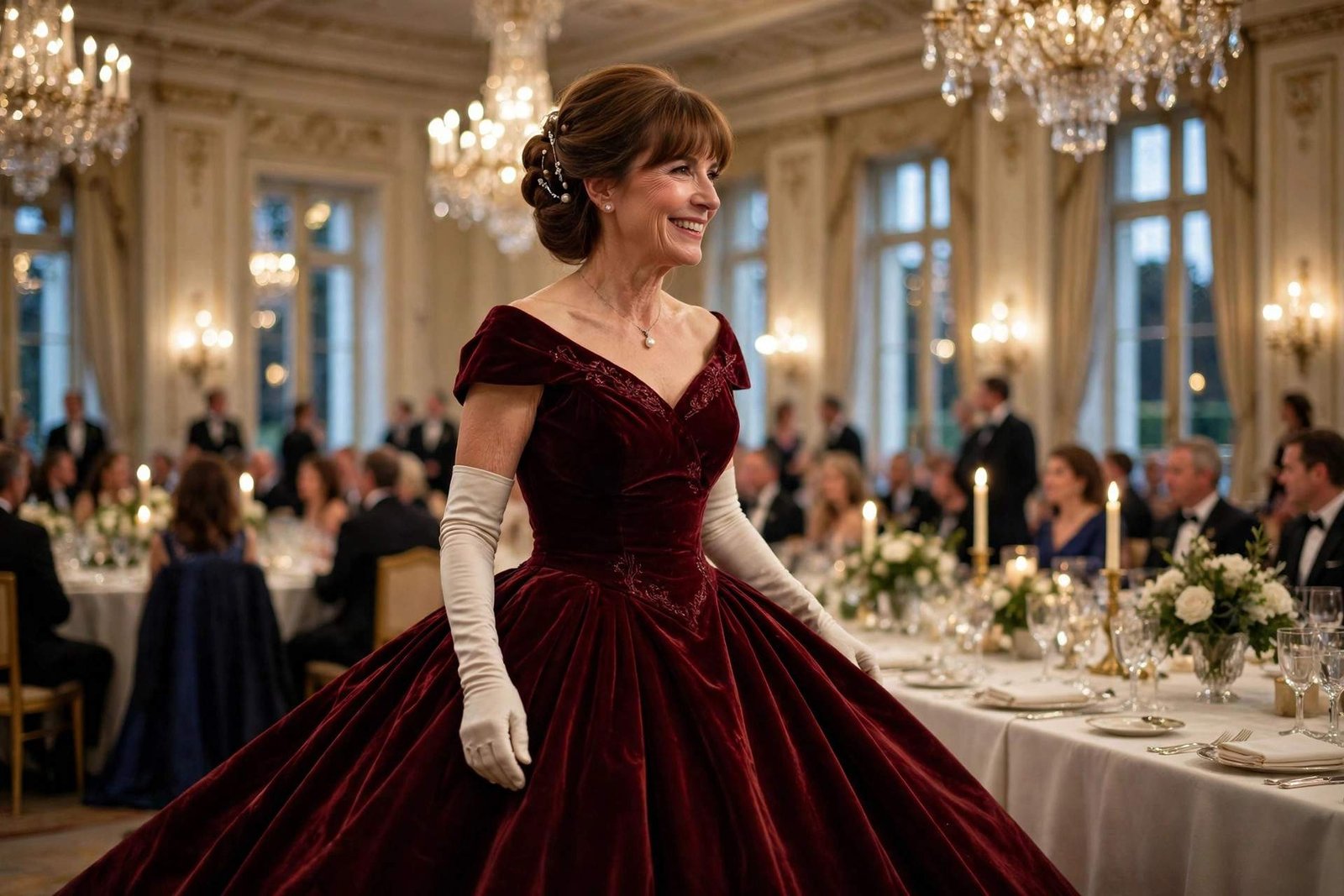
The white tie outfit for women is a full-length ball gown: a fitted bodice, a skirt that reaches the floor, and a formal fabric. Every other choice, silhouette, color, and neckline, sits inside that frame.
Full-length at white tie means the hem brushes the floor with your evening shoes on. A gown that stops at the ankle, or floats an inch above the shoe, reads as a long black tie dress, not a white tie gown. Have the gown hemmed while wearing the exact heels you plan to wear, and walk in it before the event: you should be able to move and climb a few stairs without gathering the skirt in both hands. A small train is traditional and welcome at balls. For a seated state dinner, a floor-length hem without a train is easier to manage.
The classic shape is a fitted bodice with a full skirt, but a structured A-line, a mermaid with a controlled flare, or a column gown with a detachable overskirt all meet the code when the fabric and finish are formal. Fit notes by body: petite frames carry the floor-length rule best in a slimmer A-line or column shape with a defined waist, because a very wide skirt can overwhelm a small frame, and a hem that just touches the floor keeps the line long. Plus-size frames get the most support from a structured bodice with real boning or an inner corset, and an A-line skirt that skims rather than clings. In every size, the bodice should hold its shape on its own: tugging a strapless bodice up all evening is the sign of a gown that needed alterations, not a smaller size.
Necklines stay elegant rather than daring: off-the-shoulder, sweetheart, bateau, and sleeveless cuts all appear at white tie, usually balanced by gloves or a wrap. Very low cuts and cut-out styles belong to the red carpet, not to a state dinner.
Other Options That Work
White tie has fewer alternatives than any other code, and it is better to know that plainly than to hunt for a loophole. There is no trousers version of white tie, and no jumpsuit version: both are correct at black tie and below, and both miss this code.
What does vary is the gown itself. A long-sleeved gown is a full alternative to the sleeveless-plus-gloves combination, and it is the natural choice for winter ceremonies and more traditional hosts; with long sleeves, gloves become optional. A matching stole, wrap, or evening coat handles bare shoulders and cold arrival halls. A two-piece look built from a formal bodice and a full ball skirt in the same fabric reads as one gown and passes in the same way.
If a full ball gown skirt feels like too much, a slim column gown in a heavy fabric such as velvet or mikado, worn with a detachable overskirt or a short train, keeps the ceremony of the code in a narrower line.
Colors and Fabrics That Work for White Tie
Color is the one area where white tie gives real freedom, and fabric is where the code is strict. The gown’s color is your choice; its fabric must read as evening, formal, and substantial.
| Choice | Works well | Skip |
|---|---|---|
| Colors | Black, navy, emerald, burgundy, deep jewel tones, charcoal, muted metallics | White or ivory at a wedding; neon or very bright shades; pale pastels in thin fabrics |
| Fabrics | Silk, duchess satin, velvet, taffeta, mikado, brocade, structured lace | Jersey, cotton, linen, thin unlined chiffon, casual crepe, anything that reads as a day dress |
| Patterns and finish | Solid colors, tone-on-tone brocade, fine beading kept elegant | Bold prints, large florals, heavy nightclub sequins, novelty details |
| Season | Velvet and brocade in winter, silk satin and taffeta in summer, lace year round | Cotton or linen blends at any date; heavy velvet at an outdoor summer ball |
One color warning matters more than the rest: at a white tie wedding, do not wear white, ivory, or anything that photographs as bridal. Black, by contrast, is fully correct at white tie in every setting, weddings included. The code takes its name from the men’s white bow tie, not from the color of anyone’s gown.
Shoes, Bag, Jewelry, and Gloves for White Tie
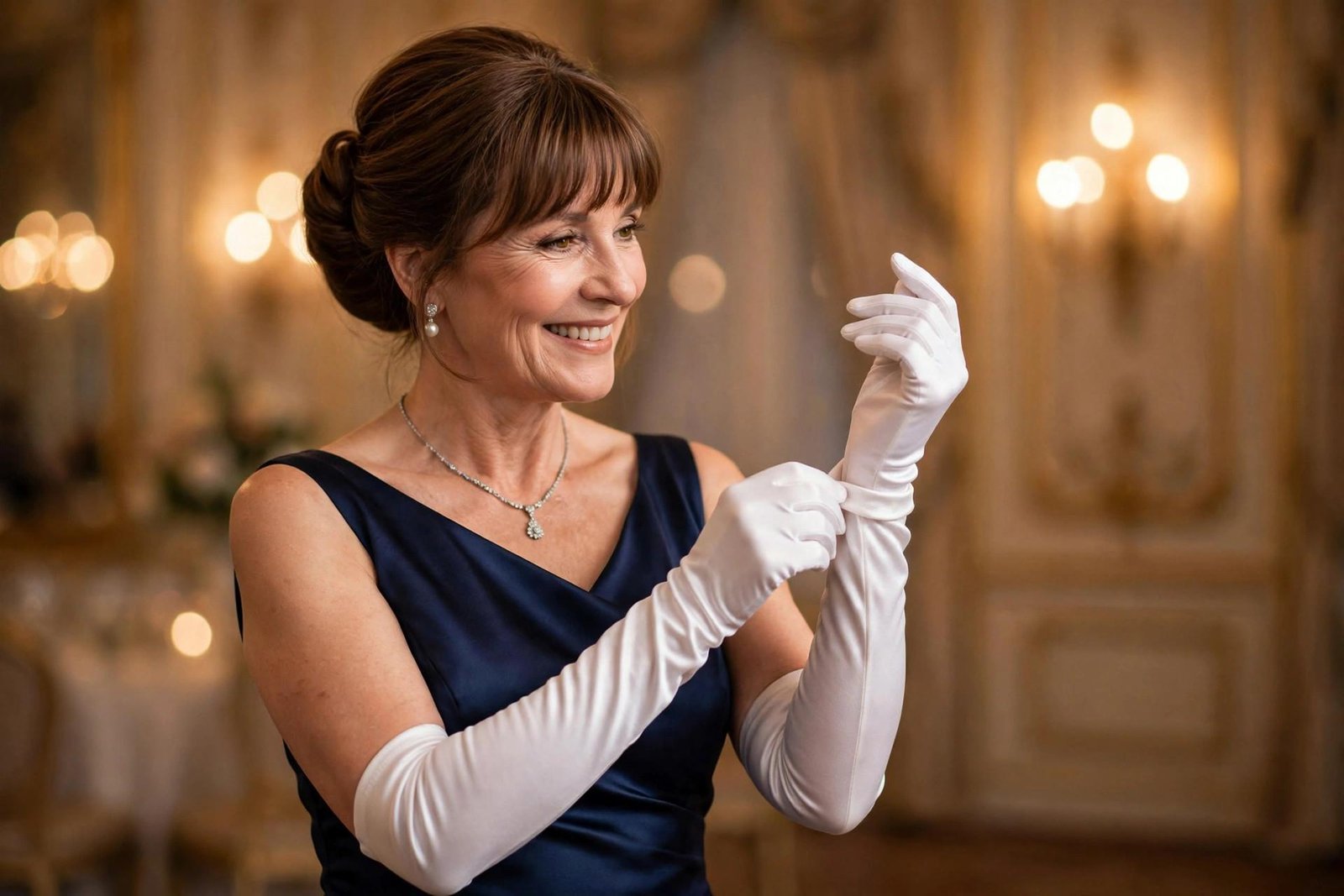
Gloves are the signature finishing piece of women’s white tie. The traditional pairing runs inverse: the shorter the sleeve, the longer the glove. With a strapless or sleeveless gown, gloves run above the elbow; with cap sleeves, to the elbow or just above; with long sleeves, gloves are optional. White and ivory are the standard colors, in silk, satin, or fine kid leather. Gloves stay on for arrival, receiving lines, and dancing, and they come off at the dinner table: nobody eats in gloves. Bracelets, if worn, go over the gloves, and rings are usually skipped.
Shoes are formal evening shoes: a closed-toe heel or an elegant court shoe in satin, silk, or patent leather that matches or complements the gown. Very high platforms and wedges fight the gown’s line; a moderate heel you can stand and dance in all evening is the right choice. The bag is a small clutch in a satin, beaded, or metallic finish, big enough for a phone, a key, and lipstick, and nothing more.
Jewelry at white tie is fine jewelry: diamonds, pearls, or precious stones, worn as a coordinated set rather than a pile-on. This is the one code where a tiara can be correct, but it belongs to royal and diplomatic settings, and tradition reserves it mainly for married women; most guests choose jeweled pins or a decorative comb instead and lose nothing. Hair is dressed up: an updo or a smooth, formal style that shows the neckline and the jewelry. Loose beach waves and an everyday ponytail are too casual for the room.
What NOT to Wear to a White Tie Event
- A cocktail dress or any knee-length dress: length is the hard rule of this code. A short dress belongs to the cocktail dress code, not to a white tie room.
- An ankle-length gown: almost floor-length is not floor-length. The hem must brush the floor in the shoes you will wear.
- A pantsuit or jumpsuit: both can be correct at black tie and below. Neither is ever correct at white tie, however formal the fabric.
- White or ivory at a wedding: the bridal colors belong to the bride, whatever the dress code says.
- Casual fabrics: jersey, cotton, linen, or a thin day-dress crepe miss the code at any length, because the fabric reads as daytime.
- Costume jewelry and a big day bag: the finishing pieces must match the gown’s level. A tote or loud costume pieces undo the whole outfit.
- A wristwatch: traditional evening etiquette leaves watches off at the most formal events. Check the time discreetly, or not at all.
White Tie vs Black Tie: What Actually Changes
White tie and black tie sit one rung apart on the ladder, but that rung changes the length rule, the finishing pieces, and the room itself.
| Code | Formality | Women: what to wear | Where you see it |
|---|---|---|---|
| Black tie optional | 5 of 7 | Floor-length gown or a formal cocktail dress; gloves not expected | Formal weddings and galas where the hosts soften the code |
| Black tie | 6 of 7 | Floor-length gown preferred, a formal cocktail dress can pass; fine or statement jewelry; gloves optional | Weddings, galas, award ceremonies, opera premieres |
| White tie | 7 of 7 | Full-length ball gown only; long gloves traditional; fine jewelry; hair worn up | State dinners, the Vienna Opera Ball, the Nobel Prize ceremony, royal events, debutante balls |
The practical difference: at black tie, a beautiful long dress with strong styling can carry the night; at white tie, the dress must be a ball gown and the finish must be ceremonial. The black tie dress code guide covers the rung below in full, and the black tie optional dress code guide covers the softer version hosts choose when they want formality without ceremony. Two rungs further down, the semi-formal dress code guide covers the level where a cocktail dress finally becomes the right answer.
White Tie in Different Settings and Seasons
The setting tunes the details. State dinners and royal events are the strictest version of the code: full gown, gloves with a sleeveless dress, fine jewelry, and no experiments. The Nobel Prize ceremony in Stockholm adds December cold: velvet, long sleeves, and a real evening coat or wrap are practical choices, not just elegant ones. At the Vienna Opera Ball and at debutante balls, dancing is the point, so choose a heel height and a skirt weight you can waltz in. A white tie wedding is the softest setting of the group: the gown rule is identical, but the jewelry can be a touch more relaxed, and the one hard color rule applies: never white or ivory.
Season changes the fabric, not the formality. Winter white tie calls for velvet, brocade, and duchess satin, with a stole or an evening coat for the arrival. Summer white tie keeps the same floor-length rule in silk satin, taffeta, or structured lace, and a sleeveless gown with long gloves handles both the heat and the tradition. White tie is always an evening code, worn after 6; there is no daytime version of it.
Common White Tie Mistakes to Avoid
- Treating white tie as dressier black tie: the length rule and the glove rule change between the two codes, not just the glamour level.
- Wearing an ankle-length gown: hem the gown to the floor, and do the fitting in the exact shoes you will wear on the night.
- Eating with gloves on: gloves come off at the dinner table and go back on afterwards for dancing.
- Wearing a tiara to a non-royal event: outside royal and diplomatic settings it draws the wrong kind of attention. Jeweled pins or a comb do the same job quietly.
- Choosing a long cocktail dress: a slinky floor-length party dress is not a ball gown. Fabric weight and structure decide, not length alone.
Conclusion: Key Takeaways
White tie comes down to three decisions, in this order. First, the gown: full-length, brushing the floor, in a formal fabric, with no shorter substitute. Second, the finish: an updo, fine jewelry, a small clutch, and long gloves if your sleeves are short or absent. Third, the restraint: no pantsuit, no cocktail length, and no white at a wedding. Get those three right and the strictest dress code on the ladder stops being intimidating.
Not sure which dress code your invitation is really asking for? Try our free Dress Code Decoder: pick the code and it lists what to wear and what to skip.
What is a white tie dress code?
White tie is the most formal evening dress code, at 7 out of 7 on the formality ladder. Women wear a full-length ball gown with formal finishing pieces, traditionally long gloves, fine jewelry, and dressed-up hair, while men wear a black tailcoat with a white bow tie and waistcoat. It appears at state dinners, royal balls, the Vienna Opera Ball, the Nobel Prize ceremony, and a small number of very formal weddings.
What is the difference between white tie and black tie?
White tie is one full step stricter. At black tie, a floor-length gown is preferred but a formal cocktail dress can pass, gloves are optional, and statement jewelry is welcome. At white tie, only a full-length ball gown passes, long gloves are traditional with sleeveless gowns, jewelry is fine rather than costume, and the events themselves are ceremonial: state dinners and royal occasions rather than weddings and galas.
Are gloves required for a white tie event?
Traditionally yes with a sleeveless or strapless gown, and they remain the expected finish at royal and diplomatic events. In modern practice outside those settings they are strongly traditional rather than strictly required, and a long-sleeved gown makes them optional. If you wear them, match the length to the sleeve, keep them white or ivory, and take them off at the dinner table.
Can a woman wear a suit to a white tie event?
No. White tie requires a floor-length gown, and there is no trousers or jumpsuit version of the code, however formal the tailoring or the fabric. A tailored evening suit is a good answer at black tie optional and at some black tie events, but a white tie invitation asks for the gown.
Can women wear black to a white tie event?
Yes. A black full-length ball gown is fully correct at white tie, in every setting, weddings included. The code is named for the white bow tie and waistcoat on the men’s side, not for the color of the women’s gowns, and black, navy, and deep jewel tones are the most common gown colors in the room.
Can you wear a tiara to a white tie event?
White tie is the only dress code where a tiara can be appropriate, but it belongs mainly to royal and diplomatic settings, and tradition reserves it for married women. At most American and social white tie events, guests skip it. Jeweled hairpins, a decorative comb, or a fine headband give the same dressed finish without the statement.

Rameen Awan is the founder and editor of Outfit Algorithm, where she breaks down outfit formulas, dress codes, and styling systems for real life. Her guides focus on practical details other sites skip: fabric behavior, fit for different body types, and what actually works when you are getting dressed in a hurry.